Forest Bathing for Corporate Teams in the UK & Ireland
Forest bathing brings science-backed nature therapy into the corporate retreat. For US companies planning leadership offsites or team wellness programs, the ancient woodlands of the UK and Ireland offer some of the most powerful forest bathing environments in Europe — and a DMC makes the logistics seamless.
Table of Contents
- What Is Forest Bathing and Why It Works for Corporate Teams
- The Science Behind Shinrin-Yoku: Measurable Wellness Outcomes
- Best Forest Bathing Locations in the UK and Ireland
- Guided vs Self-Led Sessions: Choosing the Right Format
- Building Forest Bathing Into Your Corporate Retreat Itinerary
- Seasonal Considerations and What to Expect
- Combining Forest Bathing With Other Team Activities
What Is Forest Bathing and Why It Works for Corporate Teams
Forest bathing — known in Japanese as shinrin-yoku — is a structured practice of slow, sensory immersion in a woodland environment. Developed in Japan in the 1980s as a public health initiative, it has since become one of the fastest-growing wellness practices in corporate retreat programming worldwide.
Forest bathing is a guided, evidence-based nature therapy practice that uses deliberate sensory engagement to reduce stress hormones and restore cognitive function. It is not a hike, a nature walk, or an outdoor fitness session — there is no destination, no distance goal, and no physical exertion required.
According to Qing Li’s research published in the International Journal of Environmental Research and Public Health, a single three-day forest bathing trip increased participants’ natural killer (NK) immune cells by 50%, with effects lasting up to 30 days. For corporate teams dealing with chronic workplace stress, burnout, and decision fatigue, those numbers represent a tangible return on wellness investment.
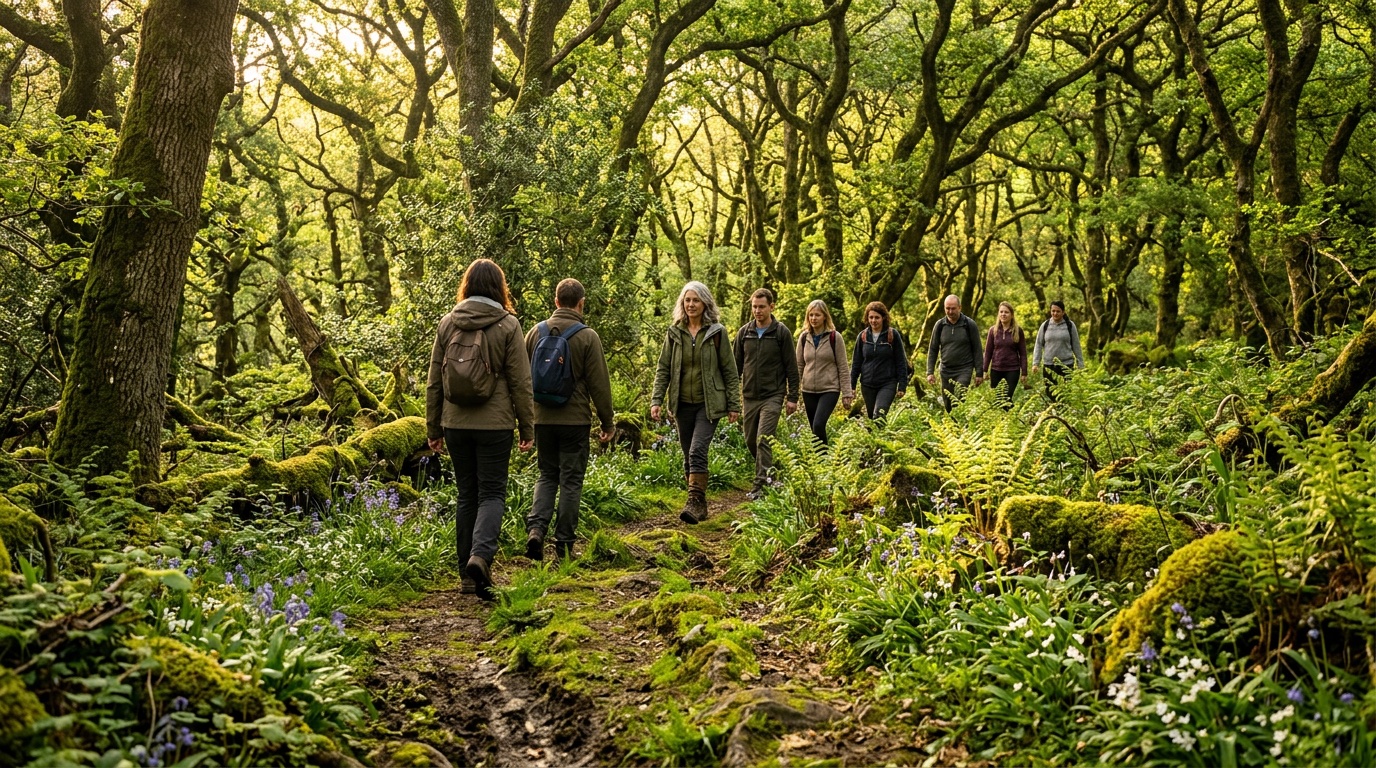
The practice follows a simple structure. A certified forest therapy guide leads a group of 8-20 people through a series of “invitations” — mindful walking, deep listening, tactile engagement with bark and moss, scent awareness of phytoncides released by trees, and a closing tea ceremony using foraged woodland plants. The entire session runs 2-3 hours and covers less than a mile of ground.
For US-based HR leaders and event planners, the appeal is clear: forest bathing delivers measurable physiological outcomes without requiring any fitness baseline, prior experience, or specialized equipment. Every member of your team can participate fully.
Explore our corporate retreat planning options to see how forest bathing fits into a broader program.
The Science Behind Shinrin-Yoku: Measurable Wellness Outcomes
The corporate case for forest bathing rests on peer-reviewed science, not anecdote. Over the past two decades, hundreds of studies have quantified the physiological and psychological effects of structured woodland immersion.
According to Miyazaki, Lee, and Park’s physiological research published in Environmental Health and Preventive Medicine, forest environments reduce salivary cortisol concentrations by an average of 12.4% compared to urban environments. The same study found significant reductions in pulse rate, blood pressure, and sympathetic nervous system activity — the body’s fight-or-flight response.
| Health Metric | Effect After Forest Bathing | Duration of Effect | Source |
|---|---|---|---|
| Salivary cortisol (stress hormone) | 12.4% reduction | 24-48 hours | Miyazaki et al., 2011 |
| NK immune cells (natural killer cells) | 50% increase | Up to 30 days | Qing Li, 2010 |
| Blood pressure (systolic) | Significant reduction | 5-7 days | Park et al., 2010 |
| Mood disturbance (POMS score) | Improved across all subscales | 7-14 days | Morita et al., 2007 |
| Prefrontal cortex activity (creative thinking) | Reduced rumination, improved divergent thought | Immediate + cumulative | Bratman et al., 2015 |
The mechanism centres on phytoncides — volatile organic compounds emitted by trees. When inhaled, these compounds trigger the body to produce anti-cancer proteins and expand the NK cell population. Coniferous forests (pine, spruce, cedar) produce the highest concentrations, which is why Scotland’s Caledonian pine forests and Ireland’s ancient woodlands are particularly effective environments.
According to the Nature Connectedness Research Group at the University of Derby, even brief nature exposure significantly improves attention restoration and cognitive performance — the exact capacities that suffer most during high-intensity corporate schedules.
Nature therapy is a complement to conventional employee wellness programs that addresses root causes of burnout. It is not a replacement for clinical mental health support or occupational health provisions.
For companies that measure employee wellness through engagement surveys and absenteeism data, forest bathing offers a pre-and-post measurement opportunity that few other retreat activities provide. Work with our DMC team to integrate wellness metrics into your retreat design.
Best Forest Bathing Locations in the UK and Ireland
The UK and Ireland contain some of Europe’s oldest and most biodiverse woodlands. For corporate groups travelling from the US, these locations combine world-class forest bathing environments with proximity to luxury accommodation, airports, and supporting retreat infrastructure.
| Location | Country | Forest Type | Nearest Airport | Best Season | Corporate Suitability |
|---|---|---|---|---|---|
| Killarney National Park | Ireland | Ancient oak & yew woodland | Kerry (KIR) / Cork (ORK) | Apr – Oct | Luxury castle hotels nearby, suitable for groups 10-60 |
| Glendalough, County Wicklow | Ireland | Mixed native & monastic valley forest | Dublin (DUB) — 90 min | Year-round | Excellent Dublin access, estate venues, groups 10-40 |
| Cairngorms National Park | Scotland | Caledonian pine forest (remnant ancient) | Inverness (INV) / Edinburgh (EDI) | May – Sep | Remote grandeur, Highland estates, groups 10-30 |
| Forest of Dean | England | Historic mixed broadleaf & conifer | Bristol (BRS) — 45 min | Year-round | Accessible from London, country house hotels, groups 10-50 |
| Snowdonia (Eryri) | Wales | Celtic temperate rainforest | Manchester (MAN) / Liverpool (LPL) | May – Oct | Unique rainforest environment, intimate groups 8-25 |
| Lake District | England | Native broadleaf & planted conifer | Manchester (MAN) — 2 hr | Apr – Oct | UNESCO site, spa hotels, groups 10-40 |
Each location offers a distinct sensory profile. Killarney’s oak-yew woodlands produce a rich, earthy atmosphere with high humidity that carries phytoncides at ground level. The Cairngorms’ ancient Caledonian pines — survivors from forests that covered Scotland 8,000 years ago — release some of the highest concentrations of alpha-pinene and limonene in the British Isles. According to Forest Research UK, Scotland’s national forest estate covers over 640,000 hectares, with designated wellness trails expanding across key sites.
Glendalough is one of Ireland’s most accessible forest bathing destinations, combining 6th-century monastic heritage with deep glacial valley woodlands. It is not a remote wilderness — Dublin is 90 minutes away, making it ideal for shorter corporate programs that need airport proximity.
For Ireland-based forest bathing retreats, our Ireland incentive travel programs include bespoke nature therapy options. Scottish woodland experiences are built into our Scotland DMC services, and English locations work seamlessly with our England DMC itineraries.
Guided vs Self-Led Sessions: Choosing the Right Format
The format of your forest bathing session determines the depth of the experience and the measurable outcomes your team takes away. For corporate groups, this decision should align with your retreat objectives and your team’s familiarity with mindfulness practices.
| Format | Duration | Group Size | Cost (GBP) | Best For | Wellness Outcome |
|---|---|---|---|---|---|
| Certified guide — full session | 2.5 – 3 hours | 8 – 15 | £60 – £90 per person | First-time groups, leadership teams, wellness-focused retreats | Maximum cortisol reduction, full sensory protocol |
| Certified guide — half day | 4 hours (inc. tea ceremony & debrief) | 8 – 20 | £90 – £140 per person | Dedicated wellness retreats, teams needing deep reset | Extended immersion, group reflection, stronger bonding |
| Self-led with briefing pack | 1 – 2 hours | Any | Minimal (briefing materials only) | Repeat sessions during multi-day retreat, morning add-on | Moderate — depends on individual engagement |
| Multi-day guided program | Daily sessions over 2-3 days | 8 – 12 | £200 – £350 per person | Executive wellness retreats, burnout recovery programs | Cumulative and lasting physiological benefits |
A guided session is the recommended format for any corporate group experiencing forest bathing for the first time. It is not optional if you want to achieve the clinical outcomes shown in the research — self-led walks in woodland, while pleasant, do not produce the same cortisol or NK cell responses without structured sensory invitations.
According to the Association of Nature and Forest Therapy, certified guides complete a minimum of 160 hours of training covering physiology, group facilitation, risk management, and botanical knowledge. In the UK and Ireland, guides are also trained in local ecology, seasonal variation, and weather-adaptive session design.
For corporate groups, we recommend a certified guided session on day one of the retreat, followed by optional self-led morning sessions on subsequent days. This gives teams the foundational experience with professional guidance, then space to return to the forest independently.
Our DMC in Ireland works with certified forest therapy guides across Killarney, Glendalough, and the Burren. For Scottish sessions, our Scotland specialists coordinate guides trained in Caledonian pine forest ecology.
Building Forest Bathing Into Your Corporate Retreat Itinerary
Forest bathing works best as a scheduled component within a broader retreat program, not as a standalone event. The key is positioning it at the right point in your agenda to maximize its restorative effect on team energy and cognitive performance.
According to research cited by the International Journal of Environmental Research and Public Health, nature exposure is most effective at reducing cognitive fatigue when placed after periods of intense mental work. This means scheduling your forest bathing session after a morning strategy workshop or a demanding planning session produces the strongest contrast and the deepest recovery.
Sample 3-day corporate retreat itinerary with forest bathing (Ireland):
| Day | Morning | Afternoon | Evening |
|---|---|---|---|
| Day 1 | Arrival at Killarney estate, welcome briefing | Guided forest bathing — Killarney National Park (3 hrs) | Group dinner, facilitated reflection |
| Day 2 | Leadership workshop / strategic planning session | Team activity — kayaking on Lough Leane or guided hike | Private whiskey tasting, informal networking |
| Day 3 | Optional dawn self-led forest walk, breakfast | Closing session — action planning & wellness commitments | Departure or optional extension |
Placing forest bathing on day one serves a strategic purpose. It sets the tone for the entire retreat — signalling that this program values presence, intention, and wellbeing alongside business objectives. Teams that begin with nature therapy report higher engagement and lower device usage throughout the remaining days.
Corporate forest bathing is most effective when integrated with reflective debrief sessions that connect the nature experience back to workplace challenges. It is not a filler activity to plug gaps in the schedule — it requires its own time block and deliberate facilitation.
For multi-day programs, consider adding a morning self-led forest walk before breakfast on days two and three. This 30-60 minute session reinforces the sensory practices learned on day one and gives individuals quiet time before group work resumes.
Our corporate retreat planning services include full itinerary design. If you’re exploring Ireland specifically, our group tours in Ireland and Ireland DMC team can build a program that balances forest bathing with cultural experiences, team activities, and strategic sessions.
Seasonal Considerations and What to Expect
Forest bathing is a year-round practice, and each season transforms the experience in ways that serve different corporate objectives. The UK and Ireland’s temperate maritime climate means forests remain accessible in all months, though session structure and logistics shift with the seasons.
| Season | Months | Daylight Hours | Phytoncide Level | Sensory Character | Best Corporate Use |
|---|---|---|---|---|---|
| Spring | Mar – May | 11 – 16 hrs | Rising | Birdsong, wildflowers, fresh green canopy, rain showers | New team formations, renewal-themed retreats |
| Summer | Jun – Aug | 15 – 17 hrs | Peak | Full canopy, warm air, highest phytoncide concentration, insect life | Maximum wellness impact, incentive retreats |
| Autumn | Sep – Nov | 9 – 14 hrs | Declining | Colour change, earthy decay scent, fungi, cooler air | Strategic planning, reflection, year-end reviews |
| Winter | Dec – Feb | 7 – 9 hrs | Low (evergreens still active) | Stillness, bare architecture, frost, muted palette | Executive burnout recovery, small leadership groups |
According to Forest Research UK’s forestry statistics, summer woodland visits in the UK peak between June and August, but corporate groups can gain a significant advantage by booking shoulder-season sessions in May or September-October when forests are quieter and guide availability is higher.
Practical preparation for your team:
- Footwear: Waterproof walking boots or trail shoes (not trainers). Forests in the UK and Ireland are damp underfoot year-round.
- Clothing: Layered, weather-appropriate. Waterproof jacket mandatory. Avoid rustling synthetics — quiet clothing enhances the sensory experience.
- Devices: Phones on silent and in pockets. The guide will set this expectation at the start.
- Physical ability: Forest bathing covers minimal distance (under a mile) at a very slow pace. It is accessible to all fitness levels, though uneven ground should be noted for anyone with mobility considerations.
Seasonal forest bathing is an opportunity to match the natural rhythm of the environment to your retreat’s thematic goals — spring for new beginnings, autumn for reflection and planning. It is not limited to summer months, and winter sessions in Scotland’s snow-dusted Caledonian pines offer an exceptionally powerful experience for small executive groups.
For seasonal retreat planning across the UK and Ireland, our Wales DMC services and England luxury travel programs offer year-round nature therapy options adapted to conditions.
Combining Forest Bathing With Other Team Activities
Forest bathing produces the strongest corporate outcomes when paired with complementary activities that build on the calm, open, and connected state it creates. The UK and Ireland’s variety of landscapes means your retreat doesn’t have to choose between nature therapy and high-energy team experiences — the best programs include both.
| Activity Pairing | Sequence | Combined Benefit | Location Example |
|---|---|---|---|
| Forest bathing + facilitated leadership workshop | Forest bathing AM → workshop PM | Reduced defensiveness, improved creative problem-solving | Glendalough, County Wicklow |
| Forest bathing + wild swimming | Forest bathing AM → guided swim PM | Compound stress reset, vagus nerve activation | Lake District, England |
| Forest bathing + whiskey/gin tasting | Forest bathing AM → distillery visit PM | Sensory continuity from nature to craft, social bonding | Cairngorms, Scotland |
| Forest bathing + coastal foraging | Forest bathing AM → foraging walk PM | Extended nature connection, hands-on learning | Pembrokeshire, Wales |
| Forest bathing + yoga or breathwork | Yoga AM → forest bathing midday | Progressive relaxation, mind-body alignment | Killarney, Ireland |
According to the Nature Connectedness Research Group at the University of Derby, nature connectedness — the degree to which someone feels psychologically embedded in the natural world — predicts sustained wellbeing improvements beyond the immediate exposure period. Pairing forest bathing with other nature-based activities extends this connectedness far beyond what a single session achieves.
The sequencing matters. Forest bathing is most effective as a morning activity that precedes higher-energy or cognitive tasks. It is not well-placed after intense physical activities like hiking or adventure sports, which raise adrenaline and shift the body into a state that opposes the parasympathetic activation forest bathing creates.
According to Bratman et al.’s Stanford research on nature and rumination, participants who walked in natural settings showed measurably reduced activity in the subgenual prefrontal cortex — the brain region associated with repetitive negative thought. This makes forest bathing an ideal precursor to strategic planning sessions where fresh thinking and openness to new ideas are essential.
For multi-activity retreats across the UK and Ireland, our shore excursions and Scotland incentive programs integrate nature therapy with cultural, culinary, and adventure experiences. Contact our team to design a combined itinerary tailored to your group.
Frequently Asked Questions
What is forest bathing and how does it work for corporate teams?
Forest bathing (shinrin-yoku) is a guided practice of slow, sensory immersion in a woodland environment. For corporate teams, a certified guide leads groups of 8-20 through a series of invitations — mindful walking, deep listening, scent awareness, and tactile engagement with natural materials. Sessions typically last 2-3 hours and require no fitness level or prior experience. The practice reduces cortisol by an average of 12.4%, lowers blood pressure, and boosts NK immune cells by up to 50%, making it one of the most evidence-based wellness interventions available for high-pressure teams. Cashel Travel coordinates certified guides across all our UK and Ireland destinations.
Where are the best forest bathing locations in the UK and Ireland for corporate groups?
The top locations for corporate forest bathing are Killarney National Park in Ireland (ancient oak-yew woodlands with luxury estate accommodation nearby), Glendalough in County Wicklow (monastic valley forests, 90 minutes from Dublin Airport), Cairngorms National Park in Scotland (remnant Caledonian pine forest with the highest phytoncide concentrations in the British Isles), the Forest of Dean in England (accessible historic mixed woodland, 45 minutes from Bristol), Snowdonia in Wales (rare Celtic temperate rainforest), and the Lake District in England (UNESCO-listed broadleaf woodland with spa hotel options). Each location can be paired with corporate retreat venues through our Ireland, Scotland, England, and Wales DMC teams.
How long should a corporate forest bathing session last?
A standard guided forest bathing session runs 2-3 hours, which is the minimum duration shown to produce measurable physiological effects including cortisol reduction and blood pressure improvement. For corporate retreats, a half-day program of 4 hours including a debrief and traditional tea ceremony works best, as it allows time for group reflection and connecting the nature experience to workplace challenges. Multi-day retreats benefit from a full guided session on day one followed by daily 60-90 minute self-led maintenance walks on subsequent mornings. Your DMC coordinator will match session duration to your overall retreat schedule.
What time of year is best for forest bathing in the UK and Ireland?
Forest bathing is effective year-round, and each season offers a distinct sensory and therapeutic profile. Summer (June-August) delivers peak phytoncide concentrations, the longest daylight hours, and full canopy cover — ideal for maximum wellness outcomes and first-time groups. Spring (April-May) brings birdsong and new growth, perfect for renewal-themed retreats. Autumn (September-October) offers dramatic colour and quieter forests at lower cost. Winter sessions are shorter but powerfully atmospheric, particularly in Scottish pine forests. For most US corporate groups, May through October is the recommended window, balancing weather reliability with strong physiological benefits. Check our seasonal planning guidance for specific destination timing.
Can forest bathing be combined with other corporate retreat activities?
Absolutely — and this is how most corporate groups experience it. Forest bathing pairs especially well with leadership workshops, strategic planning sessions, and creative brainstorming, as the parasympathetic state it creates reduces defensiveness and improves divergent thinking. A well-designed 3-day retreat might include guided forest bathing on the morning of day one, followed by facilitated team sessions in the afternoon, with optional self-led forest walks on subsequent mornings. It also complements whiskey tasting, wild swimming, coastal foraging, yoga, and cultural tours. Our DMC team builds integrated itineraries that balance nature therapy with business objectives and social experiences. Get in touch to start designing your program.
Cashel Travel is a Destination Management Company specializing in corporate retreats, incentive travel, and nature-based wellness programs across Ireland, Scotland, England, and Wales. Ready to bring forest bathing into your next corporate offsite? [Contact our team](https://casheltravel.com/contact/) to start planning.