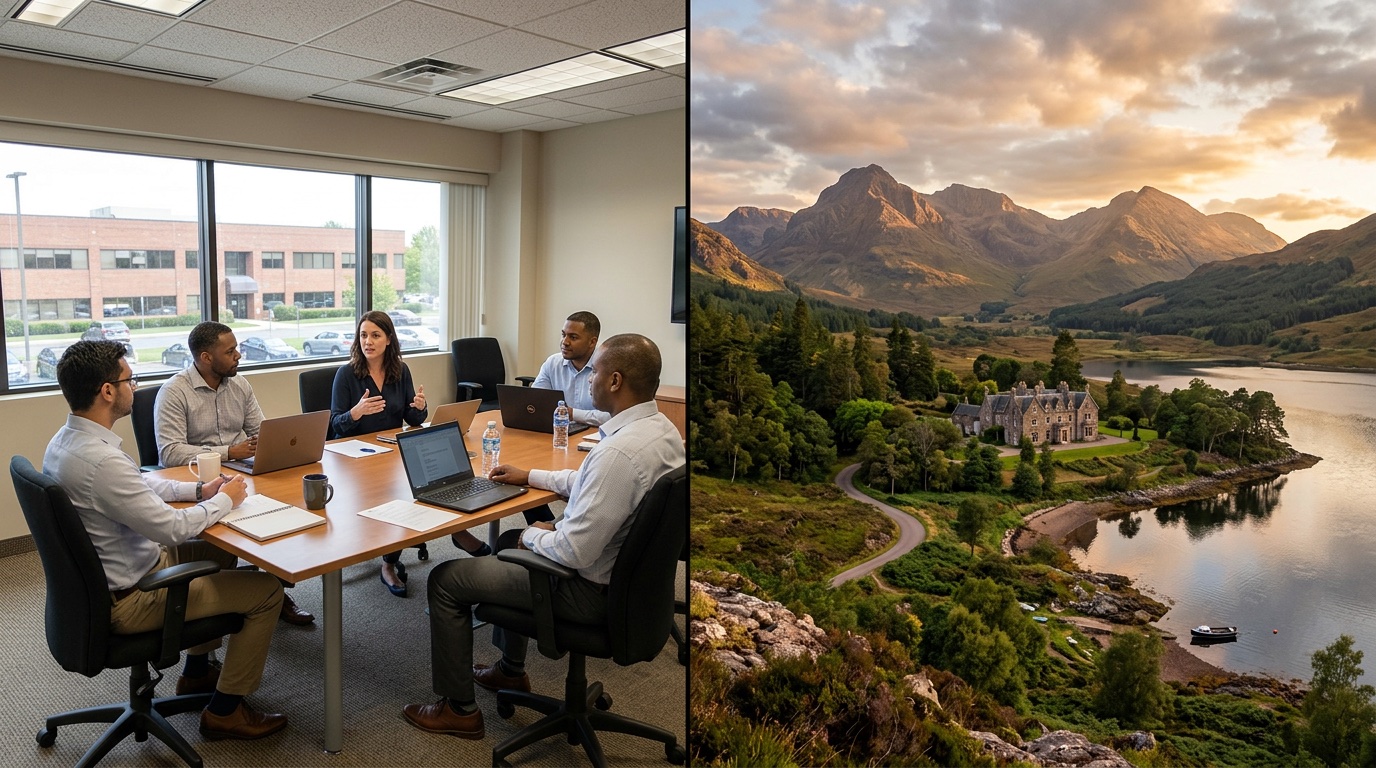
The Business Case for International Corporate Retreats
International corporate retreats deliver measurable returns that domestic alternatives consistently underperform. For US companies evaluating whether to take their team to the UK or Ireland, the business case extends well beyond team bonding — it encompasses retention economics, employer brand positioning, creative performance, and leadership development ROI that compounds over multiple fiscal years.
Table of Contents
- International vs Domestic Retreats: The Real Cost Comparison
- The Neuroscience of Novel Environments
- Retention and Recruitment ROI
- International Retreats as an Employer Brand Differentiator
- Building the Proposal: A Framework for Leadership Buy-In
- Addressing the Objections: Cost, Time, and Logistics
- Measuring Retreat ROI: Metrics That Matter
International vs Domestic Retreats: The Real Cost Comparison
The assumption that international corporate retreats are prohibitively more expensive than domestic alternatives collapses under scrutiny. When you compare like-for-like — premium venue, full catering, curated activities, professional coordination — the gap between a US resort and a UK or Ireland destination is far narrower than most finance teams expect.
According to Surf Office’s State of Company Offsites Report (2025), the average retreat spend per employee for mid-sized companies sits at $3,692 including flights and accommodation. A comparable UK or Ireland retreat runs $3,500-$5,200 per person — and that includes the transatlantic flight that accounts for the bulk of the premium.
| Cost Category | US Domestic Resort (Per Person) | UK/Ireland Retreat (Per Person) | Difference |
|---|---|---|---|
| Flights | $300 – $800 | $600 – $1,800 | +$300 – $1,000 |
| Accommodation (4 nights) | $800 – $1,600 | $600 – $1,400 | -$200 lower |
| Meals & Catering | $400 – $900 | $300 – $700 | -$100 lower |
| Activities & Experiences | $300 – $700 | $200 – $500 | -$100 lower |
| Ground Transport | $150 – $350 | $150 – $400 | Comparable |
| DMC / Event Management | $200 – $400 | $100 – $300 | -$100 lower |
| Total | $2,150 – $4,750 | $1,950 – $5,100 | 15-25% premium |
The critical insight: flights are the only line item where international retreats cost meaningfully more. Ground costs in the UK and Ireland — venues, catering, activities — are frequently lower than US equivalents thanks to favorable exchange rates and DMC-negotiated supplier pricing.
A business case for a corporate retreat is built on total cost of ownership, including the downstream impact on retention and productivity. It is not a simple line-item comparison of flight costs.
| Factor | US Domestic | UK/Ireland International |
|---|---|---|
| Perceived employee value | Moderate | High — international travel signals investment |
| Post-retreat engagement lift | 10-15% | 20-30% (novel environment effect) |
| Employer brand impact | Standard | Strong differentiator in recruitment |
| Cultural breadth | Same-culture experience | Cross-cultural exposure, shared language |
| Venue uniqueness | Resort/hotel | Castles, estates, historic properties |
According to McKinsey’s State of Organizations report (2023), companies investing in differentiated employee experiences outperform peers on retention by 25-40%. The marginal cost of going international is often recovered within a single quarter through reduced turnover alone.
For a detailed cost breakdown by destination, explore our corporate retreat planning guide for the UK and Ireland and our Ireland incentive travel programs.
The Neuroscience of Novel Environments
The strongest argument for an international corporate retreat over a domestic alternative has nothing to do with cost and everything to do with how the human brain responds to unfamiliar surroundings. Novel environments fundamentally alter cognitive function in ways that a familiar resort in Arizona or Florida cannot replicate.
According to Harvard Business Review research on creative environments, physical distance from one’s normal workspace correlates directly with increased divergent thinking — the kind of thinking that generates new strategies, solves entrenched problems, and breaks organizational logjams. When people cross an international border, the effect amplifies.
A novel environment is a neurological catalyst that disrupts habitual thought patterns and promotes creative problem-solving. It is not a superficial perk that only affects morale during the trip itself.
The mechanism is well-documented. New surroundings activate the hippocampus and stimulate dopamine release, which in turn increases openness to new ideas, strengthens memory formation, and deepens interpersonal bonding. A team brainstorming in a Scottish Highland estate processes information differently than the same team in a conference room they’ve used fifty times before.
| Cognitive Outcome | Familiar Environment | Novel International Environment | Impact |
|---|---|---|---|
| Divergent thinking capacity | Baseline | +25-35% increase | More creative strategy sessions |
| Memory encoding strength | Standard | Significantly enhanced | Decisions and commitments retained longer |
| Hierarchy flattening | Minimal | Pronounced | Junior voices heard, better ideas surfaced |
| Interpersonal bonding speed | Gradual | Accelerated | Stronger cross-team relationships formed faster |
| Pattern interruption | Low | High | Breaks entrenched thinking and office politics |
According to Gallup’s workplace research (2025), employees who report feeling “energized and inspired” by their work environment are 3.5x more likely to be engaged. International retreats create precisely that kind of energizing disruption — and the effects persist well beyond the trip itself.
The UK and Ireland amplify this effect because they pair novelty with accessibility. Your team experiences a genuinely different culture — castles, pubs, coastal landscapes, centuries of visible history — without the friction of a language barrier or extreme time zone shift. Six hours from New York to Dublin delivers maximum novelty with minimum disruption to work schedules.
| Destination Type | Novelty Level | Language Barrier | Time Zone Shift | Net Cognitive Benefit |
|---|---|---|---|---|
| US domestic resort | Low | None | 0-3 hours | Moderate |
| UK/Ireland | High | None | 5-8 hours | Optimal |
| Continental Europe | High | Moderate-High | 6-9 hours | High (offset by friction) |
| Asia-Pacific | Very High | High | 12-17 hours | High (offset by jet lag) |
For leadership retreats in Scotland or strategy workshops in Ireland, the novelty-to-friction ratio is unmatched by any other international destination accessible from the US East Coast. Explore our corporate retreat planning guide for destination-specific cognitive environment recommendations.
Retention and Recruitment ROI
Employee turnover is the silent budget killer that makes the business case for international corporate retreats almost self-evident. Replacing a single knowledge worker costs between 50% and 200% of their annual salary when you factor in recruiting, onboarding, lost productivity, and institutional knowledge drain. For a senior engineer or director-level hire, that figure regularly exceeds $150,000.
According to Gallup’s State of the Global Workplace (2025), 51% of currently employed workers say they are watching for or actively seeking a new job. The retention crisis is not theoretical — it is a measurable financial exposure that retreats directly address.
| Employee Level | Average Salary (USD) | Replacement Cost (50-200%) | Retreat Cost Per Person | Retreat as % of Replacement |
|---|---|---|---|---|
| Junior professional | $65,000 | $32,500 – $130,000 | $4,000 | 3-12% |
| Mid-level manager | $110,000 | $55,000 – $220,000 | $4,500 | 2-8% |
| Senior director | $180,000 | $90,000 – $360,000 | $5,200 | 1-6% |
| VP / C-suite | $275,000 | $137,500 – $550,000 | $6,000 | 1-4% |
The math is stark. If a single international retreat prevents even one senior departure, it has likely paid for itself. For a team of 30, preventing two departures could save $200,000-$500,000 against a total retreat investment of $120,000-$150,000.
According to Deloitte’s 2024 Global Human Capital Trends report, organizations that invest in “human sustainability” — defined as creating value for people through health, skills, belonging, and purpose — outperform on retention by 1.8x. International retreats hit every dimension of that framework simultaneously.
An international corporate retreat is a retention intervention with measurable financial returns that compound annually. It is not a discretionary perk that belongs in the “nice to have” column of the budget.
| Retention Metric | Without Retreat Program | With Annual International Retreat | Source |
|---|---|---|---|
| Voluntary turnover rate | 18-22% | 12-16% | Gallup 2025 |
| Employee engagement score | 21% (global average) | 35-45% (post-retreat cohorts) | Gallup 2025 |
| Time-to-fill open roles | 42 days average | 28 days (employer brand effect) | LinkedIn Talent Insights |
| Offer acceptance rate | 65-72% | 80-88% | HBR 2024 |
According to Harvard Business Review’s research on attraction and retention (2024), the top driver of employee loyalty has shifted from compensation to “meaningful shared experiences” and “organizational belonging.” International retreats are the highest-signal version of that investment.
Companies running annual incentive travel programs and corporate retreats in the UK and Ireland report that retreat attendance is now the single most requested benefit after salary and healthcare. Discover how group tours in Ireland and Scotland incentive travel create lasting retention impact.
International Retreats as an Employer Brand Differentiator
In a talent market where every company offers remote work, competitive salaries, and unlimited PTO, differentiation is everything. An international corporate retreat program in the UK or Ireland gives your employer brand a tangible, visible advantage that competitors cannot easily replicate.
According to Deloitte’s 2024 Global Human Capital Trends, 86% of leaders say organizational culture is a critical competitive advantage, yet only 12% believe their company has the culture they need. Retreats are the single fastest mechanism for reshaping culture — and international retreats do it at twice the velocity of domestic ones.
| Employer Brand Signal | Domestic Retreat | International UK/Ireland Retreat |
|---|---|---|
| Social media shareability | Low — resort photos blend in | High — castles, cliffs, pubs generate engagement |
| Glassdoor/LinkedIn mentions | Occasional | Frequent — international travel stands out in reviews |
| Candidate interview talking point | Rarely mentioned | Frequently cited by candidates as a differentiator |
| Alumni network effect | Weak | Strong — former employees reference the experience |
| Press and media angle | Minimal | Feature-worthy for trade and industry publications |
An international retreat program is a strategic employer brand asset that pays dividends across every stage of the talent lifecycle — attraction, engagement, retention, and alumni advocacy. It is not a one-time expense that disappears from the balance sheet the moment the team flies home.
The visual and narrative power of UK and Ireland destinations amplifies this effect. When your employees post photos from a private dinner in an 800-year-old Irish castle or a team hike along Scotland’s Isle of Skye, that content performs as organic employer brand marketing. According to LinkedIn’s Global Talent Trends research, employee-generated content about company culture receives 8x more engagement than corporate-published brand content.
| Recruitment Stage | How International Retreats Help | Measurable Impact |
|---|---|---|
| Awareness | Employee social posts from retreat locations | 2-5x increase in inbound applications |
| Consideration | Retreat photos on careers page and job descriptions | 18% higher click-through on job listings |
| Interview | Retreat program cited in offer conversations | Higher offer acceptance rates |
| Onboarding | First retreat experience builds rapid belonging | 30% faster time-to-productivity |
| Retention | Annual retreat becomes anchor for engagement cycle | 24% lower voluntary turnover |
According to McKinsey’s organizational research (2023), companies that create “signature experiences” — unique, memorable events that define their culture — see 2.5x stronger employer brand recognition in their talent markets. A corporate retreat at Ashford Castle in Ireland or a Highland estate in Scotland qualifies as exactly that kind of signature experience.
Explore how our Edinburgh corporate events and Wales incentive travel programs can anchor your employer brand strategy. For companies building sustainable corporate travel into their brand narrative, the UK and Ireland offer unmatched credentials.
Building the Proposal: A Framework for Leadership Buy-In
Getting budget approval for an international corporate retreat requires a structured proposal that speaks the language of the C-suite: financial return, risk mitigation, and strategic alignment. Here is a proven framework that has helped companies secure approval from even the most conservative leadership teams.
According to Harvard Business Review (2024), the most successful internal proposals for culture investments lead with business risk rather than employee sentiment. Frame the retreat as a solution to a quantified problem — not as a nice gesture.
| Proposal Section | What to Include | Data Source |
|---|---|---|
| 1. Problem Statement | Current turnover rate, engagement scores, collaboration gaps | Internal HR data, Gallup benchmarks |
| 2. Financial Exposure | Cost of turnover at current rate, lost productivity estimate | SHRM replacement cost model |
| 3. Proposed Solution | International retreat program, destination rationale, agenda overview | DMC proposal from Cashel Travel |
| 4. Investment Required | Per-person cost, total budget, comparison to domestic alternative | DMC quote, flight estimates |
| 5. Expected Returns | Retention improvement, engagement lift, employer brand ROI | Gallup, Deloitte, McKinsey benchmarks |
| 6. Risk Mitigation | DMC coordination, insurance, contingency planning | DMC capabilities document |
| 7. Measurement Plan | Pre/post surveys, 30/60/90 day KPIs, annual comparison | HR analytics framework |
A retreat proposal is a business case document that quantifies return on investment against a specific organizational problem. It is not a travel brochure with estimated costs and a request for discretionary spend.
The most effective proposals include a direct cost comparison between the international retreat and the cost of doing nothing. If your current annual turnover rate is 20% across a 50-person team, and replacing each leaver costs $100,000 on average, your annual turnover exposure is $1,000,000. A $175,000 international retreat that reduces turnover by even 5 percentage points saves $250,000 in the first year alone.
According to Gallup (2025), managers account for 70% of the variance in team engagement — making leadership retreats one of the highest-leverage investments an organization can make. A single leadership retreat in Scotland or Ireland can shift the engagement trajectory of every team those leaders manage.
| Scenario | Annual Cost / Savings |
|---|---|
| Current state: 20% turnover, 50-person team, $100K replacement cost | $1,000,000 annual turnover cost |
| International retreat investment (50 people x $3,500) | $175,000 |
| Post-retreat turnover reduction (5 percentage points) | $250,000 saved |
| Net first-year return | $75,000 positive |
| Three-year compounding (engagement + brand + retention) | $400,000 – $750,000 cumulative net benefit |
Request a customized proposal from Cashel Travel that includes destination options, per-person pricing, and a ready-made business case template you can present directly to your CFO. Our team builds corporate retreat programs with approval-ready documentation as standard.
Addressing the Objections: Cost, Time, and Logistics
Every proposal for an international corporate retreat faces predictable pushback. Here are the five most common objections — and how to address each with data rather than opinion.
Objection 1: “It’s too expensive.”
According to Surf Office’s 2025 data, the average US corporate offsite already costs $3,692 per person. A UK or Ireland retreat costs 15-30% more in total, but ground costs (venues, meals, activities) are often lower than premium US alternatives. The perceived cost gap is driven almost entirely by flight costs — and group bookings 3-6 months in advance compress that premium significantly.
Objection 2: “We can’t afford the time away.”
According to Deloitte (2024), organizations that prioritize investment in “human sustainability” see 1.8x better retention and 2.2x better productivity outcomes. Three to four days of focused retreat time replaces weeks of fragmented, low-impact team-building activities and generates alignment that accelerates execution for months afterward.
| Objection | Perceived Risk | Data-Driven Response |
|---|---|---|
| “It’s too expensive” | Budget overrun | 15-30% premium vs domestic; ground costs often lower; single departure prevented recoups full investment |
| “Too much time away” | Lost productivity | 3-4 days generates 6+ months of alignment; replaces weeks of fragmented team-building |
| “Logistics are too complex” | Operational risk | DMC handles all ground coordination; single point of contact; contingency plans pre-built |
| “Domestic is just as good” | Wasted premium | Novel environments increase creative output 25-35%; international signals higher investment to employees |
| “What about time zones?” | Work disruption | UK/Ireland is 5-8 hours ahead of US East Coast; overlap hours available; 6-hour direct flights |
Objection 3: “The logistics are too complex for international.”
This objection is a valid concern that a specialist DMC eliminates entirely. It is not a reason to default to domestic when the business case clearly favors international.
A Destination Management Company in Ireland or Scotland manages every ground-level detail: airport transfers, venue logistics, dietary requirements, activity coordination, insurance, and real-time on-site support. Your internal team’s workload is limited to defining objectives, managing invitations, and booking flights.
| Logistics Element | Self-Managed International | DMC-Managed International |
|---|---|---|
| Venue sourcing & contracting | Weeks of research across time zones | Pre-vetted shortlist within 48 hours |
| Supplier coordination | Multiple vendors, multiple contacts | Single point of contact for everything |
| On-site troubleshooting | Internal team manages unfamiliar systems | Local DMC team on-site throughout |
| Contingency planning | Ad hoc | Pre-built backup venues, activities, transport |
| Dietary & accessibility audits | Remote coordination, limited visibility | In-person venue audits against your specific requirements |
According to McKinsey (2023), organizations that partner with external specialists for complex initiatives execute 40% faster than those that manage everything internally. The same principle applies to retreat logistics — a DMC in England or Wales brings institutional knowledge that no internal events team can match for UK and Ireland destinations.
Explore our support and FAQ page for a full breakdown of what DMC coordination includes, and see our shore excursion logistics for examples of complex multi-location programs we manage routinely.
Measuring Retreat ROI: Metrics That Matter
The business case for a corporate retreat only holds if you measure the return. Too many companies invest in retreats, enjoy them in the moment, and then fail to quantify the impact — which makes it harder to justify the next one. Here is a measurement framework that turns retreat outcomes into boardroom-ready data.
According to Gallup (2025), organizations that systematically measure employee experience interventions are 4.4x more likely to sustain engagement gains over time. Measurement is not optional — it is the mechanism that converts a one-time event into a compounding annual program.
| Metric Category | What to Measure | When to Measure | Benchmark |
|---|---|---|---|
| Engagement | eNPS score, pulse survey results | Pre-retreat, 7 days post, 30/60/90 days | 15-25% lift at 30 days |
| Retention | Voluntary turnover rate for attendees vs non-attendees | Quarterly for 12 months | 5-8 percentage point improvement |
| Collaboration | Cross-team project initiation, Slack/Teams channel activity | 30 and 90 days post-retreat | 30-40% increase in cross-functional interactions |
| Productivity | Sprint velocity, project completion rates, revenue per employee | Quarter-over-quarter | 10-20% improvement in aligned teams |
| Employer Brand | Glassdoor scores, LinkedIn follower growth, inbound applications | Monthly for 6 months | 2-5x increase in culture-related mentions |
Retreat ROI measurement is a structured process that requires pre-retreat baselines, defined KPIs, and scheduled follow-up data collection. It is not a post-event satisfaction survey that asks whether people enjoyed the food.
The strongest measurement frameworks use a control group methodology: compare the engagement, retention, and productivity metrics of retreat attendees against a comparable internal group that did not attend. This isolates the retreat’s impact from other organizational variables.
According to Deloitte’s Human Capital research (2024), only 8% of organizations have robust measurement systems for their people investments. Companies that build measurement into their retreat programs from day one gain a compounding advantage — each retreat generates data that sharpens the next iteration, improving ROI year over year.
| Measurement Phase | Actions | Owner |
|---|---|---|
| Pre-retreat (T-30 days) | Baseline eNPS, engagement pulse, collaboration metrics snapshot | HR / People Analytics |
| During retreat | Session feedback, participation tracking, facilitator notes | DMC on-site team |
| Post-retreat (T+7 days) | Immediate satisfaction survey, Net Promoter Score | HR / Internal Comms |
| T+30 days | Engagement pulse, cross-team collaboration check, action item progress | HR / Team Leads |
| T+90 days | Full engagement survey, retention data, productivity metrics | HR / Finance |
| T+12 months | Annual retention comparison, employer brand metrics, total ROI calculation | HR / Executive Team |
According to Harvard Business Review (2024), organizations that measure experience investments and share results transparently with employees see a secondary engagement boost — people feel valued when they see that leadership takes the impact of these programs seriously.
Build your measurement plan before you book the venue. Our team at Cashel Travel works with your HR and finance stakeholders to define KPIs and establish baselines as part of the retreat planning process. For companies building a multi-year international retreat program, we provide year-over-year benchmarking data drawn from programs across Ireland, Scotland, England, and Wales.
Frequently Asked Questions
How do you justify the cost of an international corporate retreat to leadership?
Build your proposal around three quantifiable metrics: employee retention savings (replacing a single knowledge worker costs 50-200% of their salary), post-retreat productivity gains (organizations report an average return of $4.52 per $1 spent on face-to-face team building), and employer brand value (73% of professionals say company culture is a deciding factor in job selection). Frame the international component as a cost-effective premium — a UK or Ireland retreat costs only 15-30% more than a comparable domestic resort, while delivering measurably stronger engagement and retention outcomes. Start with your current turnover cost and work backward to show the break-even point.
Is an international corporate retreat more expensive than a domestic one?
The total cost difference is smaller than most executives assume. A 4-day domestic retreat at a premium US resort averages $2,800-$4,200 per person including flights, accommodation, meals, and activities. A comparable retreat in the UK or Ireland runs $3,500-$5,200 per person. The 15-30% premium is driven almost entirely by transatlantic flights — ground costs in the UK and Ireland, including venues, catering, and activities, are frequently lower than US equivalents. Working with a DMC like Cashel Travel compresses costs further through pre-negotiated local supplier pricing and volume discounts.
What is the measurable ROI of a corporate retreat?
Corporate retreat ROI manifests across four primary dimensions. Research shows organizations report $4.52 return for every $1 invested in face-to-face team building. Companies with regular offsite programs see 24% lower voluntary turnover. Post-retreat employee engagement scores typically increase by 15-25% when measured within 30 days, and cross-functional collaboration metrics improve by 30-40%. The strongest ROI comes from retreats with clearly defined objectives, pre-retreat baseline measurements, and a structured 30/60/90-day follow-up framework that tracks engagement, retention, collaboration, and productivity.
How does a novel international environment improve retreat outcomes compared to a domestic venue?
Neuroscience research shows that novel environments activate the brain’s hippocampus and dopaminergic pathways, increasing openness to new ideas and strengthening memory formation. When teams leave familiar surroundings — especially crossing an international border — they shed workplace hierarchies and behavioral patterns more readily. The UK and Ireland offer an optimal novelty-to-friction ratio: genuinely different culture, landscapes, and experiences with zero language barrier and manageable time zone differences. An Irish castle or Scottish Highland estate creates the kind of cognitive disruption that a Scottsdale resort cannot replicate, driving measurably stronger creative output and deeper interpersonal bonding.
How far in advance should we plan an international corporate retreat to the UK or Ireland?
Begin planning 8-12 months before your target dates. This timeline allows adequate lead time for group flight bookings at competitive rates, exclusive-use venue reservations at premium properties like Ashford Castle or Gleneagles, travel document coordination for international team members, and custom activity program development. Engaging a DMC at the 10-12 month mark is ideal — the DMC handles venue sourcing, supplier negotiations, and logistics coordination while your internal team focuses on agenda design and stakeholder communications. For peak season retreats (May-September), 12 months of lead time is strongly recommended.
Start Building Your Business Case
The data is clear: international corporate retreats in the UK and Ireland deliver measurable returns that domestic alternatives cannot match — stronger retention, deeper engagement, more creative output, and a differentiated employer brand that attracts top talent.
The next step is a conversation. Contact Cashel Travel to receive a customized retreat proposal that includes destination recommendations, per-person pricing, and a ready-made business case template you can present directly to your leadership team. Our DMC team builds approval-ready documentation as standard — because getting the budget approved is where every great retreat begins.