Sustainable Corporate Travel in the UK & Ireland
Sustainable corporate travel in the UK and Ireland is a structured approach to planning group business trips that actively reduces environmental impact while meeting program objectives. For US companies sending teams across the Atlantic, the UK and Ireland now offer one of the most developed green travel infrastructures in Europe — from BREEAM-certified conference venues to electrified rail networks and nationally backed sustainability pledges.
Table of Contents
- The Carbon Cost of Transatlantic Corporate Travel
- Green-Certified Venues Across the UK and Ireland
- Low-Carbon Ground Transport for Corporate Groups
- Local Sourcing and Sustainable Catering
- Carbon Offset Programs That Meet Corporate Standards
- ESG Reporting and Scope 3 Compliance for Business Travel
- How Cashel Travel Delivers Sustainable Group Programs
- FAQ
The Carbon Cost of Transatlantic Corporate Travel
Understanding the emissions profile of a transatlantic group trip is the first step toward reducing it. A sustainable corporate travel program isn’t simply buying carbon offsets after the fact — it means making lower-carbon choices at every stage of the journey.
According to the ICAO Carbon Emissions Calculator, a single round-trip economy flight from New York to London generates approximately 1.12 tonnes of CO2e per passenger. Business class travelers produce nearly three times that figure — around 3.24 tonnes CO2e one way — due to the larger seat footprint and lower passenger density.
| Cabin Class | CO2e Per Passenger (One Way, JFK–LHR) | Multiplier vs Economy |
|---|---|---|
| Economy | ~1.12 tonnes | 1x |
| Premium Economy | ~1.79 tonnes | 1.6x |
| Business | ~3.24 tonnes | 2.9x |
| First | ~4.48 tonnes | 4x |
According to the GBTA 2025 Sustainability Benchmark, only 15% of corporations purchased Sustainable Aviation Fuel (SAF) certificates in 2025 — up from 12% in 2024 — showing that adoption is growing but remains limited. For a group of 30 travelers, the cabin class decision alone can swing total flight emissions by over 60 tonnes of CO2e.
Practical steps US travel managers can take include booking premium economy instead of business class for shorter programs, selecting airlines with active SAF blending programs, choosing direct routing to minimize fuel burn, and consolidating travel dates to reduce the total number of flights. Cashel Travel works with clients to model these trade-offs during the trip planning phase, providing carbon projections before any bookings are confirmed.
Green-Certified Venues Across the UK and Ireland
The UK and Ireland have invested heavily in green building certification for conference and event venues. A green-certified venue is a property that has been independently assessed and rated against recognized environmental performance standards such as BREEAM, LEED, or the Green Tourism scheme.
According to VisitScotland’s Green Certification guidance, the Green Tourism scheme is the world’s largest sustainable certification program for tourism and hospitality businesses, assessing operations across energy use, waste management, water conservation, ethical purchasing, and biodiversity.
| Venue | Location | Certification | Capacity |
|---|---|---|---|
| The Crystal | London | LEED Platinum + BREEAM Outstanding | 500 |
| QEII Centre | Westminster, London | BREEAM Excellent | 2,500 |
| The Spine | Liverpool | BREEAM Outstanding + WELL Platinum | 350 |
| EICC | Edinburgh | Net-Zero Roadmap, Zero Landfill | 2,000 |
| ACC Liverpool | Liverpool | Platinum ECOsmart | 1,350 |
| Convention Centre Dublin | Dublin | ISO 20121, Fáilte Ireland Climate Action | 2,000 |
This isn’t just about the building’s energy rating. Green-certified venues typically operate zero-to-landfill waste policies, source renewable energy, offer plant-forward catering menus, and provide delegates with refillable water stations rather than single-use plastic.
According to Fáilte Ireland’s Climate Action Programme, Ireland is targeting a 50% emissions reduction across the tourism sector by 2030, with fully subsidized advisory programs helping venues measure and cut their environmental impact. Cashel Travel maintains a curated database of green-certified venues across every region we operate in, from the Scottish Highlands to the Wild Atlantic Way, so your group’s environmental standards are met regardless of destination.
For US companies unfamiliar with European certification systems, our sustainability page provides a full comparison of BREEAM, LEED, Green Tourism, and ISO 20121 standards to help you evaluate venue options alongside your CSR team.
Low-Carbon Ground Transport for Corporate Groups
Once your group arrives in the UK or Ireland, ground transport choices determine a significant portion of the trip’s remaining carbon footprint. Sustainable ground transport is the combination of rail, electric coaches, and hybrid vehicles that replaces conventional diesel coach transfers and domestic flights.
According to Eurostar’s sustainability data, a London-to-Paris Eurostar journey produces up to 93% less CO2 per passenger than the equivalent flight. Within the UK, services like LNER (London to Edinburgh), Avanti West Coast (London to Manchester and Glasgow), and GWR (London to Bristol and Cardiff) provide viable rail alternatives that cut emissions dramatically compared to domestic flights or diesel coaches.
| Transport Mode | CO2e per Passenger-km | Suitability for Groups (20–50 pax) |
|---|---|---|
| Domestic Flight | ~255g | Fast but highest emissions |
| Diesel Coach | ~89g | Flexible routing, moderate emissions |
| Electric Coach | ~30g | Growing fleet, ideal for city-to-city |
| Intercity Rail | ~41g | Lowest emissions, fixed routes |
| Eurostar (International Rail) | ~6g | London–Paris/Brussels, ultra-low carbon |
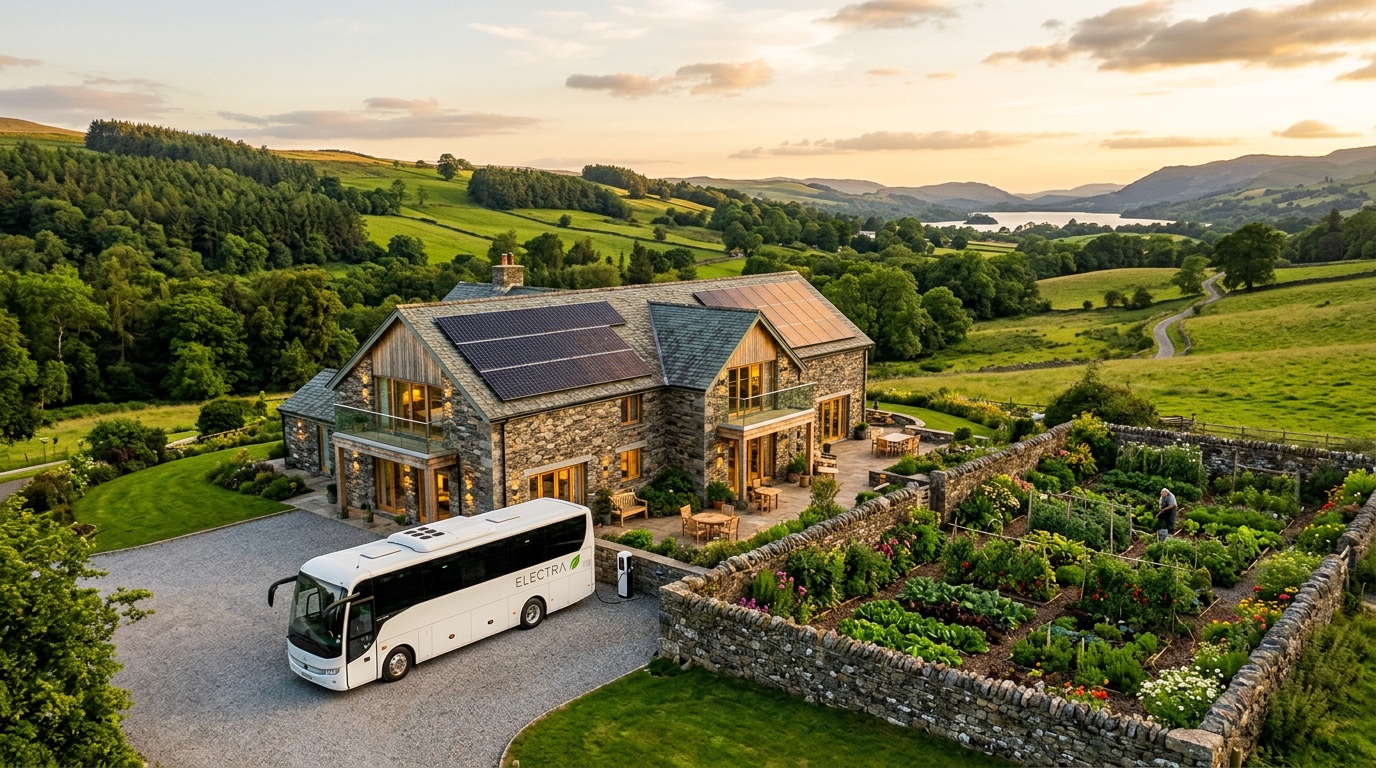
The UK electric coach market is expanding rapidly. According to Sustainable Bus, zero-emission bus and coach registrations rose 62.2% year-on-year in 2025 to 2,523 units, accounting for 27.3% of all new registrations. This isn’t a niche option anymore — it is a practical choice for corporate group transfers across most major UK and Irish routes.
Cashel Travel arranges group transport that prioritizes rail for intercity legs and electric or hybrid coaches for transfers and excursions. For incentive programs that include scenic routes — such as the Wild Atlantic Way or the Scottish Highlands — we pair electric vehicles with strategic charging stops that double as experience touchpoints, turning a sustainability choice into a program highlight.
Local Sourcing and Sustainable Catering
Food and beverage accounts for a meaningful share of any corporate event’s environmental footprint. Sustainable catering is the practice of sourcing seasonal, local, and ethically produced ingredients to minimize food miles, reduce waste, and support regional economies.
The UK and Ireland are exceptionally well positioned for local sourcing. Ireland’s grass-fed dairy and beef industry operates with some of the lowest carbon intensity in Europe according to Bord Bia’s Origin Green programme, while Scotland’s seafood industry supplies sustainably caught shellfish and salmon directly from coastal waters to venue kitchens. English and Welsh farms produce seasonal vegetables, artisan cheeses, and heritage grain breads within short supply chains.
| Sourcing Approach | Average Food Miles | Carbon Impact | Cost Comparison |
|---|---|---|---|
| Imported (International Supply Chain) | 3,000–8,000 miles | High | Variable |
| National (UK/Ireland Supply Chain) | 100–500 miles | Moderate | Comparable |
| Local (Within 50 Miles of Venue) | Under 50 miles | Low | Often Lower |
| On-Site / Kitchen Garden | 0 miles | Minimal | Lowest (Seasonal) |
According to UNWTO’s Global Tourism Plastics Initiative, the hospitality sector is a leading contributor to single-use plastic waste — and catering is a primary driver. Green-certified venues across the UK and Ireland have largely eliminated single-use plastics from their food service operations, replacing them with compostable or reusable alternatives.
This isn’t limited to formal dining. Cashel Travel works with venue partners and local suppliers to build sustainability into every food touchpoint: welcome receptions using seasonal canapes, working lunches with plant-forward menus, gala dinners featuring regional produce with full provenance documentation, and even coffee breaks stocked by local roasters. For programs that include team-building experiences, we can incorporate farm visits, cooking workshops with local chefs, or whiskey distillery tours that highlight the connection between terroir and sustainable production. Every menu we propose on our catering page includes a sustainability score alongside dietary and allergen information.
Carbon Offset Programs That Meet Corporate Standards
Even with the best planning, transatlantic corporate travel produces residual emissions that cannot be eliminated through efficiency alone. A credible carbon offset program is one that uses independently verified standards — such as Gold Standard, Verified Carbon Standard (VCS), or United Nations Certified Emission Reductions (CERs) — to retire carbon credits from projects that deliver measurable, additional, and permanent emissions reductions.
According to the Gold Standard Foundation, Gold Standard certification requires projects to demonstrate not only verified carbon reductions but also contributions to at least three UN Sustainable Development Goals. This dual requirement sets it apart from less rigorous voluntary offset schemes.
| Offset Standard | Verification Level | SDG Requirement | Accepted for ESG Reporting |
|---|---|---|---|
| Gold Standard | Third-Party Verified | 3+ SDGs Required | Yes |
| Verified Carbon Standard (Verra VCS) | Third-Party Verified | Optional Co-Benefits | Yes |
| UN Certified Emission Reductions (CERs) | UNFCCC Verified | Varies by Project | Yes |
| Unverified / Self-Certified | None | None | No |
This isn’t a box-ticking exercise. According to Carbon Neutral Britain, effective corporate offset programs should complement — not replace — genuine emissions reduction efforts. The recommended approach is a carbon management hierarchy: avoid, reduce, substitute, then offset the remainder.
Cashel Travel partners with verified UK and Ireland-based offset projects including peatland restoration in Scotland, native woodland planting in Ireland, and community renewable energy schemes across Wales. We integrate offset calculations into every trip proposal, presenting the residual carbon figure alongside the offset cost so your team can make an informed decision. Full offset documentation — including project certificates and retirement confirmations — is provided for your sustainability records and ESG disclosures.
ESG Reporting and Scope 3 Compliance for Business Travel
Corporate travel falls squarely within Scope 3 Category 6 (Business Travel) of the Greenhouse Gas Protocol — and regulatory pressure on Scope 3 disclosure is accelerating on both sides of the Atlantic. Scope 3 business travel reporting is the process of measuring, documenting, and disclosing the greenhouse gas emissions generated by employee travel that is paid for or reimbursed by the organization.
According to Aligned Incentives’ regulatory analysis, two major frameworks are converging: California’s SB 253 requires companies with over $1 billion in annual revenue to report Scope 3 emissions starting in 2027 (for FY 2026 data), while the EU’s Corporate Sustainability Reporting Directive (CSRD) mandates Scope 3 disclosure for large companies operating in or trading with the EU.
| Regulation | Jurisdiction | Scope 3 Requirement | First Reporting Year |
|---|---|---|---|
| California SB 253 | US (California) | Mandatory for $1B+ revenue companies | 2027 (FY 2026) |
| EU CSRD | EU / Non-EU Parents | Mandatory where material | 2028 (FY 2027) |
| UK Streamlined Energy and Carbon Reporting | UK | Recommended (mandatory for large companies) | Already Active |
| SEC Climate Disclosure | US (Federal) | Scope 1 & 2 (Scope 3 currently paused) | Under Review |
According to the GBTA’s 2025 benchmark, 79% of large organizations now have formal sustainable procurement policies for travel, up from 53% in 2022 — reflecting the growing urgency around auditable sustainability practices. This isn’t a future concern; it is a current compliance reality for most Fortune 500 companies.
Cashel Travel provides every client with a post-trip carbon emissions report that breaks down CO2e by transport mode, accommodation, venue operations, and catering. These reports are formatted for direct integration into GHG Protocol-aligned Scope 3 disclosures and can be adapted to meet the specific requirements of your corporate sustainability framework. We work closely with your CSR and finance teams during the planning phase to ensure all tracking methodologies are agreed before travel begins — not retrofitted afterward.
How Cashel Travel Delivers Sustainable Group Programs
Cashel Travel is a specialist Destination Management Company (DMC) for the UK and Ireland with sustainability embedded into every stage of program design and delivery. We do not treat green travel as an add-on; it is integrated into our standard operating procedures from initial scoping through to post-trip reporting.
Our approach follows four principles:
1. Measure First: Every program begins with a carbon baseline. We model projected emissions across flights, ground transport, venues, accommodation, and catering before any bookings are made, giving your travel manager and CSR director a clear picture of the environmental cost alongside the financial budget.
2. Reduce by Design: We prioritize green-certified venues, rail-based itineraries, electric ground transport, locally sourced catering, and accommodations with verified sustainability credentials. According to the GBTA’s Sustainability Acceleration Challenge, 285 companies representing $22 billion in annual travel spend now participate in structured sustainability benchmarking — and our program design aligns with these frameworks.
3. Offset the Remainder: Residual emissions are offset through verified Gold Standard and VCS projects based in the UK and Ireland, with full documentation provided.
4. Report and Improve: Post-trip carbon reports, supplier sustainability scorecards, and year-on-year benchmarking data help your organization demonstrate continuous improvement in its travel program’s environmental performance.
This isn’t theoretical. Cashel Travel has delivered sustainable programs for corporate groups ranging from 15-person executive retreats in the Scottish Highlands to 200-person incentive programs spanning London, Dublin, and Edinburgh. Our case studies document the measurable sustainability outcomes of each program. Visit our sustainability page to review our own environmental commitments and certifications, or explore our destinations to see how green infrastructure varies by region across the UK and Ireland.
FAQ
How can US companies reduce the carbon footprint of transatlantic corporate travel to the UK and Ireland?
US companies can significantly reduce transatlantic travel emissions through several practical steps. Booking economy or premium economy class instead of business class cuts per-passenger CO2 by up to 67%. Choosing direct flights eliminates the additional fuel burn of connections. Selecting airlines that actively blend Sustainable Aviation Fuel (SAF) further reduces the emissions profile of each seat. According to the GBTA’s 2025 benchmark, SAF certificate purchases among corporates rose to 15% in 2025. Once in the UK or Ireland, switching to intercity rail and electric coach transfers for ground transport can reduce in-country emissions by over 80% compared to domestic flights and diesel coaches. Cashel Travel models these options during the planning phase so your team can make informed decisions before any bookings are confirmed.
What green-certified conference venues are available in the UK and Ireland for corporate events?
The UK and Ireland offer a strong selection of independently certified green venues. In London, The Crystal holds dual LEED Platinum and BREEAM Outstanding certifications with capacity for 500 delegates. The QEII Centre in Westminster carries a BREEAM Excellent rating and accommodates up to 2,500. Liverpool’s The Spine achieved BREEAM Outstanding and is pursuing WELL Platinum certification. Edinburgh’s EICC operates on a verified net-zero roadmap with a zero-landfill commitment. In Ireland, the Convention Centre Dublin runs an active sustainability program aligned with Fáilte Ireland’s Climate Action Programme. Cashel Travel maintains a curated list of green-certified venues across all our operating regions and can match your group size, program format, and sustainability requirements to the right property.
Does sustainable corporate travel in the UK and Ireland cost more than standard programs?
Sustainable corporate travel does not inherently cost more, and in several areas it can reduce expenses. Rail travel between major UK cities is frequently cheaper than equivalent domestic flights, particularly when booked in advance for groups. Locally sourced catering often costs less than imported alternatives because it eliminates long supply chain markups. While carbon offsets add a marginal cost — typically 1–3% of the total travel budget — energy-efficient green-certified venues can offer competitive hire rates thanks to lower operating costs. The key is designing the program with sustainability integrated from the start rather than retrofitting green options onto a conventional itinerary. Cashel Travel provides transparent cost comparisons between standard and sustainable options for every trip proposal so your finance team can see exactly where the budget shifts.
How does sustainable corporate travel support ESG reporting requirements?
Business travel falls under Scope 3 Category 6 of the Greenhouse Gas Protocol. Under California’s SB 253, US companies with over $1 billion in revenue must report Scope 3 emissions starting in 2027 for FY 2026 data. The EU’s CSRD mandates similar disclosure for companies trading within the EU. Working with a DMC that tracks emissions at the activity level — flights, ground transport, venue energy, accommodation, and catering — provides the granular data required for these disclosures. Cashel Travel delivers a post-trip carbon emissions report formatted for direct integration into GHG Protocol-aligned Scope 3 disclosures. This documentation supports both mandatory compliance and voluntary sustainability commitments, providing auditable evidence for your corporate sustainability program.
What is a DMC’s role in planning sustainable group travel to the UK and Ireland?
A Destination Management Company (DMC) like Cashel Travel functions as your local sustainability partner on the ground. Our role spans venue sourcing with green-certified properties, arranging low-carbon ground transport including rail bookings and electric coach hire, coordinating with seasonal and local food suppliers, managing verified carbon offset purchases, and producing post-trip emissions documentation for ESG reporting. Because we operate exclusively in the UK and Ireland, we maintain direct relationships with certified venues, transport operators, and offset project managers — ensuring sustainability commitments translate into verified action rather than aspirational policy. Explore our full service offering on our services page or contact us to discuss your program requirements.
Ready to plan a sustainable corporate travel program in the UK and Ireland? Cashel Travel designs every group trip with measurable environmental performance built in — from carbon baseline modeling to post-trip ESG reporting. Contact our team to start the conversation and receive a sustainability-scored proposal tailored to your group’s objectives.