Shore Excursions UK & Ireland for Corporate Groups
When your corporate cruise docks at a UK or Ireland port, the shore excursion becomes the highlight of the trip. This guide covers how to plan private, DMC-arranged shore excursions at every major British Isles port — from logistics and timing to excursion types that deliver real incentive value for US-based corporate groups.
Table of Contents
- Why Shore Excursions Matter for Corporate Cruise Programmes
- Major UK & Ireland Cruise Ports at a Glance
- Types of Corporate Shore Excursions
- DMC vs Cruise-Line Excursions: What Corporate Planners Need to Know
- Port Logistics: Dock Ports, Tender Ports & Turnaround Times
- Seasonal Planning & Booking Timelines
- Building Team Connection During Shore Time
Why Shore Excursions Matter for Corporate Cruise Programmes {#why-shore-excursions-matter}
British Isles cruises have become one of the fastest-growing segments in corporate incentive travel. According to the Cruise Lines International Association (CLIA), the UK and Ireland welcomed over 1.9 million cruise passengers in 2024, with corporate and incentive charters accounting for an increasing share of that traffic. For US-based event planners, a multi-port itinerary across Ireland, Scotland, England, and Wales offers a rare combination: diverse cultural experiences without the complexity of flights between destinations.
A shore excursion is a curated, time-bound experience designed to showcase the best of a destination within the hours your ship is in port. It is not simply free time at port with a bus transfer to the nearest town square.
The difference matters for corporate groups. When 40 to 200 incentive winners step off a ship in Dublin or Edinburgh, the excursion sets the tone for how they perceive the entire programme. A generic coach tour with 50 strangers communicates cost-cutting. A private whiskey-blending workshop at a historic distillery, arranged exclusively for your group by a local destination management company, communicates prestige and intentionality.
According to VisitBritain’s inbound tourism research, US visitors to the UK rate “unique local experiences” as the top factor influencing trip satisfaction — ahead of accommodation quality and dining. Shore excursions are the single best opportunity to deliver that.
Major UK & Ireland Cruise Ports at a Glance {#major-cruise-ports}
Not every port offers the same opportunities. The distance from quayside to key attractions, the type of berthing (dock versus tender), and the surrounding region’s density of corporate-suitable venues all vary significantly. The table below compares the six ports most frequently included on British Isles cruise itineraries relevant to corporate groups.
| Port | Country | Berthing Type | Typical Time in Port | Top Corporate Excursion | Transfer to City Centre |
|---|---|---|---|---|---|
| Dublin | Ireland | Dock | 8–10 hours | Private city tour + whiskey distillery | 15 min |
| Cork / Cobh | Ireland | Tender / Dock | 6–8 hours | Blarney Castle + Jameson Midleton | 25 min to Cork city |
| Belfast | Northern Ireland | Dock | 8–10 hours | Titanic Quarter + Giant’s Causeway | 10 min |
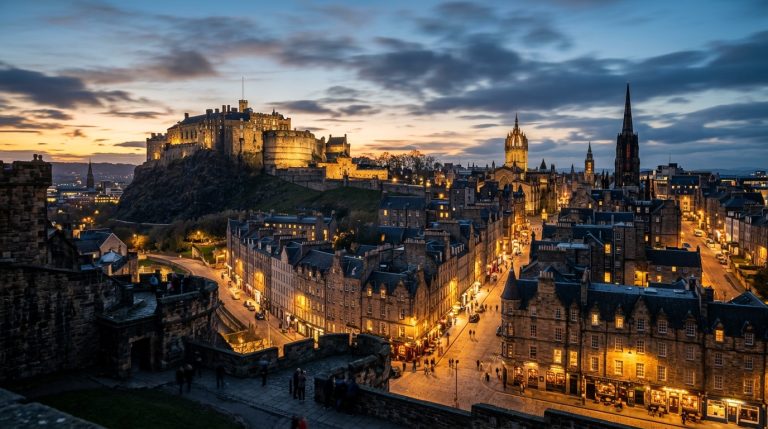
| Edinburgh (Leith / South Queensferry) | Scotland | Dock / Tender | 8–10 hours | Castle + Scotch whisky experience | 20 min (Leith) / 35 min (S. Queensferry) |
| Liverpool | England | Dock | 8–10 hours | Beatles heritage + Albert Dock | 5 min |
| Southampton | England | Dock | Turnaround port | Stonehenge + Winchester day trip | 10 min |
Dublin and Belfast offer the most versatile options for corporate groups because of their compact city centres, abundance of premium venues, and strong local DMC infrastructure. Cashel Travel operates across all six ports through its destination network, with specialist teams in Ireland, Scotland, England, and Wales.
According to Failte Ireland’s tourism data, cruise tourism contributes over EUR 60 million annually to the Irish economy, with Dublin and Cobh handling the majority of ship calls. For corporate planners routing incentive cruises through Ireland, this infrastructure translates to reliable transport networks, experienced local guides, and venues accustomed to hosting private groups.
Types of Corporate Shore Excursions {#types-of-excursions}
The best corporate shore excursions combine cultural authenticity with an element of exclusivity that participants could not easily arrange on their own. Below are the six excursion categories most requested by US corporate groups visiting the UK and Ireland, along with the ports where each type is strongest.
| Excursion Type | Best Ports | Ideal Group Size | Typical Duration | Corporate Value |
|---|---|---|---|---|
| Private guided city tour | Dublin, Edinburgh, Belfast, Liverpool | 10–60 | 2–3 hours | Orientation + cultural context |
| Whiskey / gin distillery visit | Dublin, Cork, Edinburgh | 10–40 | 2–3 hours | Shared tasting experience |
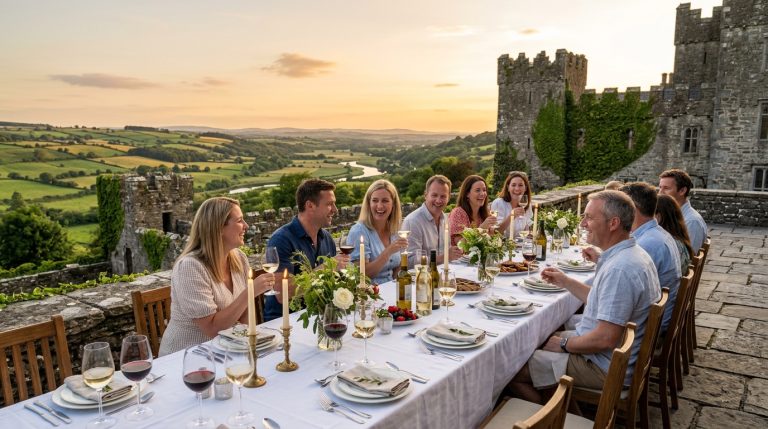
| Castle experience with private dining | Edinburgh, Dublin, Belfast | 20–120 | 3–5 hours | High-impact incentive reward |
| Coastal adventure (RIB boats, cliff walks) | Cork, Belfast (Causeway Coast), Edinburgh | 10–30 | 2–4 hours | Active team building |
| Culinary immersion (market tours, cooking) | Cork (English Market), Liverpool, Dublin | 10–30 | 2–3 hours | Interactive group engagement |
| Cultural heritage programme | Belfast (Titanic), Liverpool (Beatles), Southampton (historic) | 20–80 | 3–4 hours | Storytelling + shared memory |
A shore excursion is a strategic programming decision that shapes how participants remember the entire cruise. It is not a checkbox item that can be left to last-minute arrangements at the port.
For incentive programmes in Ireland, the most requested combination is a morning private city tour of Dublin followed by an exclusive whiskey-blending experience at a craft distillery, finishing with a private lunch at a Georgian townhouse. In Scotland, Edinburgh Castle access before public opening hours paired with a Scotch whisky masterclass consistently ranks as the top excursion format.
DMC vs Cruise-Line Excursions: What Corporate Planners Need to Know {#dmc-vs-cruise-line}
Every major cruise line offers a menu of shore excursions at each port. For individual leisure travellers, these are convenient. For corporate groups, they present serious limitations. Understanding the distinction is critical for planners managing incentive budgets and participant expectations.
A DMC-arranged excursion is a fully private, bespoke programme built around your group’s specific objectives, schedule, and brand standards. It is not a rebadged version of the same tour available to every passenger on the ship.
The practical differences break down across five dimensions:
Exclusivity. Cruise-line excursions mix your group with other passengers. A DMC guarantees private transport, private guides, and private venue access. When your CEO is addressing the incentive winners over a whiskey tasting, there are no strangers in the room.
Customisation. Cruise-line options are fixed itineraries. A DMC like Cashel Travel designs the itinerary around your programme themes, dietary requirements, mobility considerations, and branding. Need the company logo projected at a castle dinner? Done. Need a Gaelic football match organised for the team-building segment? Arranged.
Cost transparency. Cruise lines apply a markup of 30 to 50 percent on shore excursions, according to industry analysis published by Cruise Critic. A DMC negotiates directly with local suppliers and passes through actual costs with a transparent management fee.
Reliability. This is where cruise-line excursions hold one advantage: if a cruise-line tour runs late, the ship waits. Independent excursions operate under a strict all-aboard deadline. However, experienced DMCs build buffer time into every itinerary and maintain real-time communication with port agents to eliminate this risk. Cashel Travel assigns a dedicated programme manager to every shore excursion who monitors timing throughout the day.
Local expertise. Cruise-line excursion operators are often national bus companies subcontracted for the season. A DMC employs or retains specialist local guides year-round, with deep knowledge of each destination and established relationships with venues. Review Cashel Travel’s case studies for examples of how local expertise transforms a standard port visit into something participants talk about for years.
Port Logistics: Dock Ports, Tender Ports & Turnaround Times {#port-logistics}
The single most important logistical factor in shore excursion planning is time — specifically, the window between when your group can realistically disembark and when they must be back on board. Understanding port types and transfer distances prevents the most common planning mistake: overloading an itinerary that runs past the all-aboard deadline.
Dock ports (Dublin, Belfast, Liverpool, Southampton, and most Edinburgh calls at Leith) allow the ship to berth directly at a quayside terminal. Passengers walk off the ship and onto coaches. Disembarkation for a pre-arranged group with priority tender tickets or group clearance typically begins 30 to 45 minutes after the ship docks.
Tender ports (Cobh in Cork Harbour, and occasionally South Queensferry near Edinburgh) require passengers to take a small boat from the anchored ship to shore. This adds 20 to 40 minutes each way and introduces weather dependency. On rough days, tender operations can be delayed or cancelled entirely.
For corporate groups, the practical calculation is straightforward. Take the published time in port, subtract one hour for disembarkation and re-boarding buffer, and plan excursion content within the remaining window. On a typical 8-hour Dublin call, that gives you approximately 7 hours of usable excursion time — enough for a full morning and afternoon programme.
According to CLIA’s port operations guidelines, major UK ports have invested significantly in terminal infrastructure since 2020, reducing average disembarkation times by approximately 15 percent. Dublin Port’s new cruise berth at Alexandra Quay West, operational since 2023, can handle ships up to 340 metres and places groups within a 15-minute coach transfer of the city centre.
A DMC’s value in logistics planning cannot be overstated. Cashel Travel pre-positions coaches at the terminal, pre-clears group manifests with port authorities where possible, and builds route-specific timing plans for each destination that account for traffic patterns on cruise ship days.
Seasonal Planning & Booking Timelines {#seasonal-planning}
The British Isles cruise season runs from April through October, with the heaviest concentration of ship calls between May and September. Seasonality affects not just weather but venue availability, daylight hours, guide availability, and pricing.
| Month | Weather Outlook | Daylight Hours | Cruise Traffic | Venue Availability | Recommended For |
|---|---|---|---|---|---|
| April | Cool, mixed showers | 13–15 hrs | Low | High | Budget-conscious groups |
| May | Mild, improving | 15–16 hrs | Moderate | High | Best overall value |
| June | Warm, long days | 16–17 hrs | High | Moderate | Premium incentive programmes |
| July–August | Warmest, busiest | 15–17 hrs | Peak | Low — book early | Large groups with early planning |
| September | Mild, less crowded | 12–14 hrs | Moderate | Moderate | Best weather-to-crowds ratio |
| October | Cool, shorter days | 10–12 hrs | Low | High | End-of-season value |
For corporate planners, the booking timeline is critical. Exclusive venue hires at castles and distilleries during June through August are often reserved 6 to 12 months in advance. Specialist guides — particularly Scotch whisky experts in Edinburgh and Irish historians in Dublin — book out for peak-season cruise days months ahead.
The recommended planning sequence for DMC-arranged shore excursions:
- 6–12 months out — Confirm cruise itinerary and port dates with Cashel Travel; secure exclusive venue reservations.
- 4–6 months out — Finalise excursion itineraries, transport specifications, and guide assignments.
- 2–3 months out — Confirm group numbers, dietary requirements, and mobility needs.
- 2 weeks out — Final briefing with ship-side coordination and contingency plans.
According to VisitBritain’s cruise tourism strategy, advance planning is particularly important for ports like Edinburgh during the Edinburgh Festival period (August), when competition for venues, transport, and guides peaks dramatically. A DMC with year-round local presence — not a seasonal operator — is essential for securing the best options.
Building Team Connection During Shore Time {#team-building-shore-time}
Shore excursions are an underutilised opportunity for corporate team building. Most planners treat port days as leisure time, but the shared experience of exploring a new destination together — especially in a curated, private setting — creates stronger interpersonal bonds than a generic team-building workshop back at the office.
The most effective corporate shore excursions weave team interaction into cultural experiences rather than bolting on a forced activity. Examples that work consistently for US corporate groups at UK and Ireland ports:
Dublin — Whiskey blending challenge. Teams of 4 to 6 create their own blend from single pot still, grain, and malt whiskeys at a private distillery space, judged by a master blender. The competitive element is light, the learning is genuine, and every participant takes home a labelled bottle of their team’s creation.
Edinburgh — Castle quest and Scotch masterclass. A guided exploration of Edinburgh Castle with team-based discovery challenges, followed by a tutored Scotch whisky tasting at a private members’ venue on the Royal Mile. This format blends active movement with a sit-down shared experience.
Belfast — Titanic Quarter innovation workshop. Using the Titanic story as a framework for a facilitated session on innovation, risk, and leadership, held in a private space within Titanic Belfast. Particularly effective for technology and financial services groups.
Cork — English Market culinary team challenge. Teams navigate Cork’s historic English Market with a local chef guide, sourcing ingredients for a competitive cook-off at a private kitchen venue. Combines cultural immersion with genuine collaboration under time pressure.
The key principle: the destination itself becomes the team-building mechanism. There is no need for artificial icebreakers when your group is navigating the streets of a historic city together, solving problems, sharing discoveries, and creating stories they will retell at the office for months.
For more on how Cashel Travel structures corporate programmes that balance leisure with purposeful team engagement, explore our case studies or get in touch directly.
Frequently Asked Questions
How long do corporate groups typically have for a shore excursion in the UK or Ireland?
Most cruise ships allow between 6 and 10 hours at UK and Ireland ports. The exact window depends on whether the port is a dock port (such as Dublin, Southampton, or Liverpool) or a tender port (such as Cobh). Dock ports generally offer longer effective windows because passengers disembark directly onto the quayside, while tender ports require a short boat transfer that can reduce usable excursion time by 30 to 60 minutes. A destination management company plans excursions that maximise every available hour, factoring in transfer distances and all-aboard deadlines. For most ports, corporate groups can expect approximately 5 to 8 hours of structured excursion content after accounting for disembarkation and re-boarding buffers.
What is the difference between booking shore excursions through a cruise line versus a DMC?
Cruise-line excursions are standardised group tours shared with other passengers, often using large coaches and visiting heavily touristed sites with limited flexibility. A DMC such as Cashel Travel designs fully private, bespoke itineraries exclusive to your corporate group. DMC-arranged excursions offer flexibility on timing, private transport, exclusive venue access, and the ability to incorporate team-building elements or branded touches. Pricing is often comparable or lower because DMCs negotiate local supplier rates directly without the cruise line’s 30 to 50 percent markup. The one trade-off is that cruise-line excursions guarantee the ship will wait if the tour runs late, while independent excursions operate under a strict all-aboard time — though experienced DMCs build buffer time into every programme to eliminate this risk entirely.
Which UK and Ireland cruise ports are best for corporate shore excursions?
The top ports for corporate groups are Dublin (extensive city and countryside options within easy reach), Edinburgh via Leith or South Queensferry (castles, whisky distilleries, the historic Old Town), Belfast (Titanic Quarter and the Giant’s Causeway day trip), Cork via Cobh (distilleries, harbour tours, Blarney Castle), Liverpool (cultural heritage, Albert Dock, and Beatles legacy), and Southampton (gateway to Stonehenge, Winchester, and the Cotswolds). Dublin and Edinburgh offer the widest range of premium corporate venues. Belfast provides the best value-to-impact ratio. Cork delivers the most authentic Irish cultural experiences. Cashel Travel operates across all these ports through its destinations network.
What types of shore excursions work best for corporate incentive groups?
The most popular corporate shore excursions fall into six categories: private guided city tours for cultural orientation, whiskey or gin distillery experiences with exclusive tastings and blending workshops, castle visits with private dining or reception events, coastal adventure activities such as RIB boat tours or guided cliff walks, culinary experiences including market tours and private cooking challenges, and cultural heritage programmes such as the Titanic Belfast innovation workshop or Liverpool’s Beatles story. The strongest itineraries blend two or three experience types within the port time window. For example, a morning city walking tour in Edinburgh followed by a private Scotch whisky masterclass and castle lunch creates a varied, memorable day. Explore options for Ireland incentives and Scotland incentives.
When is the best time of year for UK and Ireland cruise shore excursions?
The British Isles cruise season runs from April through October. May and September offer the best balance of favourable weather, long daylight hours (15+ hours in May, 12–14 in September), and lower crowding at attractions and venues. June through August delivers the warmest weather and longest days but brings peak cruise traffic and the highest competition for exclusive venues and specialist guides. April and October are viable shoulder months with good availability and lower pricing, but carry higher probability of rain and shorter daylight windows. Corporate groups should secure DMC arrangements and exclusive venue bookings 6 to 12 months in advance for peak-season dates, and at least 3 to 6 months ahead for shoulder season. Contact Cashel Travel to begin planning around your cruise itinerary dates.
Ready to plan shore excursions that your corporate group will remember long after the cruise? Cashel Travel is a specialist UK and Ireland DMC with dedicated teams at every major cruise port. Whether you need a private castle dinner in Edinburgh, a whiskey-blending challenge in Dublin, or a full multi-port programme across six destinations, we handle every detail — from quayside coach positioning to the final all-aboard countdown. Get in touch with our team to start building your bespoke shore excursion programme.