Cork & Wild Atlantic Way for Corporate Groups
“`html
“`
Cork city and the Wild Atlantic Way coastline form one of Ireland’s most compelling destinations for US corporate incentive groups and business events. This guide covers venues, activities, dining, logistics, and the DMC expertise needed to deliver an exceptional programme across Ireland’s southwest.
Table of Contents
- Why Cork and the Wild Atlantic Way for Corporate Groups
- Cork City: Food, Culture, and Corporate Venues
- Kinsale and West Cork Coastline
- Luxury Venues and Hotels for Corporate Groups
- Group Activities: Distilleries, Kayaking, and Whale Watching
- Getting There: Cork Airport and Transfer Options
- Combining Cork with the Ring of Kerry
Why Cork and the Wild Atlantic Way for Corporate Groups
Cork is Ireland’s second city and one of Europe’s rising incentive destinations — it is not a smaller version of Dublin but a distinct region with its own culinary identity, coastline, and heritage that deliver a fundamentally different corporate experience. For US planners designing reward trips, Cork and the Wild Atlantic Way provide the combination of exclusivity, gastronomy, and dramatic landscape that top-performing incentive programmes require.
According to the Cork Convention Bureau, Cork hosted over 140 international conferences and corporate events in 2024, with North American groups representing the fastest-growing source market. The city’s compact size — walkable end to end in 20 minutes — means delegates move between venues, restaurants, and cultural experiences without long transfers or complex logistics.
According to Failte Ireland’s Wild Atlantic Way data, the 2,500-kilometre coastal route attracted over 3 million visitors in its latest reporting year, with the West Cork and Beara Peninsula sections consistently rated among the most visually dramatic stretches. For incentive groups, the Wild Atlantic Way is not a single road but a network of coastal drives, peninsulas, and harbour towns that a Destination Management Company can sequence into a multi-day programme of escalating impact.
| Factor | Cork & Wild Atlantic Way | Typical European Incentive Destination |
|---|---|---|
| English-speaking | Yes — no translation costs | Not always |
| Michelin-starred dining | Multiple restaurants within 40 km | Varies by destination |
| Coastline access | Wild Atlantic Way on doorstep | Often requires long transfers |
| Group hotel rate (5-star, per night) | EUR 220–EUR 400 | EUR 400–EUR 700 |
| Whiskey distillery experiences | Midleton (Jameson) — 25 min from city | Rarely within city radius |
Cork is a destination where food is the defining cultural experience — it is not a region that relies on a single headline attraction but one where the culinary scene, from the English Market to Kinsale’s seafood restaurants, provides the narrative thread that ties the entire programme together. According to Tourism Ireland, Cork’s food reputation now rivals established European gastronomic destinations, and delegate feedback consistently identifies the dining experiences as the programme highlight.
| Programme Component | Cork & Wild Atlantic Way Strength |
|---|---|
| Welcome reception | English Market private evening hire with local producers |
| Team activities | Whale watching, sea kayaking, distillery blending, cooking classes |
| Gala dinner | Castlemartyr Resort, Ballymaloe House, or Kinsale harbour venue |
| Day excursion | West Cork coastline drive or Beara Peninsula loop |
| Heritage experience | Cobh — Titanic’s last port of call |
For US planners comparing destinations across the UK and Ireland, Cork delivers the authenticity and exclusivity of a regional destination with the infrastructure and accessibility of a major city. Our DMC Ireland overview explains how we build multi-region itineraries that combine Cork with Dublin, Kerry, or the wider Wild Atlantic Way.
Cork City: Food, Culture, and Corporate Venues
Cork city is Ireland’s food capital — it is not a claim made casually but a designation earned through the English Market, a concentration of Michelin-recognised restaurants, and a craft beer and artisan food scene that has no equivalent anywhere else on the island. For corporate groups, Cork city provides 1–2 days of immersive urban programming before the Wild Atlantic Way coastline begins.
According to the Cork Convention Bureau, the city’s compact centre is built across two channels of the River Lee, and the principal venues, hotels, and restaurants sit within a 15-minute walking radius. This matters for incentive planners because it eliminates the coach-dependency that plagues larger cities and gives delegates the freedom to explore between scheduled activities.
The English Market has operated continuously since 1788 and was famously visited by Queen Elizabeth II during her historic 2011 state visit to Ireland. According to Failte Ireland, the market is one of Ireland’s most visited food attractions, housing over 50 traders selling artisan cheese, charcuterie, fresh fish, and baked goods under its ornate Victorian roof. For corporate groups, the English Market can be hired for private evening receptions with guided tastings led by the traders themselves.
| Cork City Dining | Distinction | Private Group Capacity | Best For |
|---|---|---|---|
| Ichigo Ichie | Michelin star (Japanese-Irish kaiseki) | Omakase counter 12, full buyout 28 | Executive dinners |
| Greenes Restaurant | Michelin Bib Gourmand | 65 seated | Group dinners in waterfall courtyard |
| Market Lane | Local favourite, Irish ingredients | 40 seated (private floor) | Casual group dining |
| Elbow Lane Brew & Smokehouse | Craft brewery and restaurant | 50 seated, 80 standing | Team evening with craft beer tasting |
| Hayfield Manor — Perrott’s Garden Bistro | Five-star hotel dining | 80 seated | Formal group dinner |
Cork’s craft beer scene adds a distinctive element. Rising Sons Brewery, Cotton Ball, and Franciscan Well Brewery (now owned by Molson Coors but still brewing on-site) all offer private group tastings and brewery tours. According to Tourism Ireland, craft beverage tourism is one of the fastest-growing activity categories for international visitors, and Cork leads Ireland in brewery density per capita.
| Cork City Venue | Type | Conference Capacity | Signature Feature |
|---|---|---|---|
| Cork City Hall | Civic venue | 1,000 (concert hall) | Riverside location, Art Deco architecture |
| Cork International Hotel | Conference hotel | 600 | Adjacent to Cork Airport |
| The River Lee Hotel | 4-star city centre | 350 | Floor-to-ceiling river views |
| Hayfield Manor | 5-star boutique | 80 | Private gardens, exclusive hire available |
Cork’s cultural depth extends well beyond food — it is not a one-dimensional destination. The Crawford Art Gallery, Cork Opera House, and the Shandon Bells at St Anne’s Church all provide venues for private corporate receptions. For planners building incentive programmes in Ireland, Cork city provides the ideal urban opening before groups head west along the Wild Atlantic Way. Our case studies include examples of Cork-based incentive itineraries.
Kinsale and West Cork Coastline
Kinsale is Ireland’s undisputed gourmet capital and one of the most rewarding day trips for any Cork-based incentive group — it is not a tourist village with a few restaurants but a genuine food destination with a culinary heritage dating back to the 1970s Kinsale Gourmet Festival, one of the oldest food festivals in Ireland. Sitting just 25 kilometres south of Cork city, Kinsale provides a half-day or full-day extension that dramatically elevates any corporate programme.
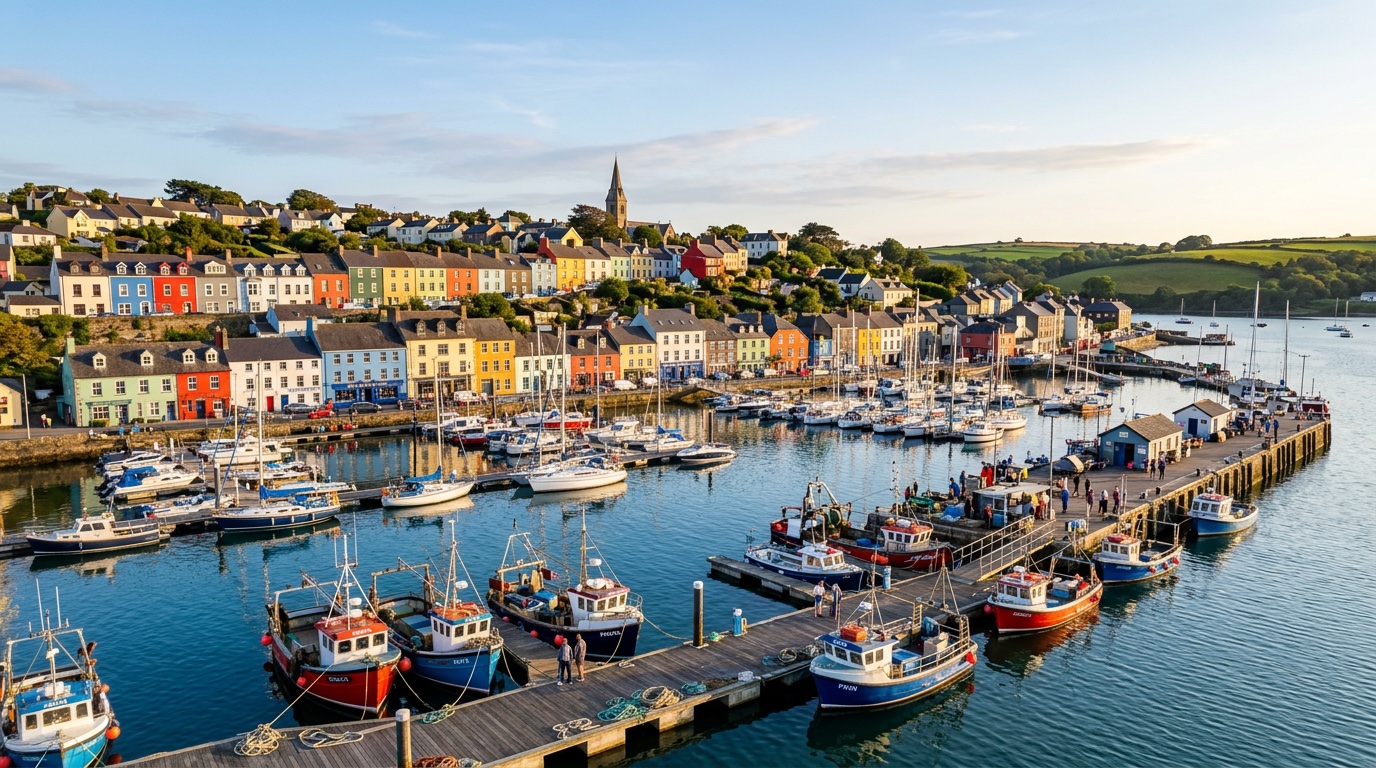
According to the Wild Atlantic Way official guide, Kinsale marks the starting point of the Wild Atlantic Way’s southernmost section, and the town’s harbour, 17th-century star fort (Charles Fort), and colourful streetscape deliver an instant visual impact that US delegates consistently rate as a trip highlight.
| Kinsale Experience | Group Size | Duration | Season |
|---|---|---|---|
| Guided gourmet food trail | 10–40 | 3 hours | Year-round |
| Charles Fort private guided tour | Up to 60 | 1.5 hours | Year-round |
| Harbour kayaking | Up to 24 | 2 hours | April–October |
| Private cookery demonstration | 10–30 | 2.5 hours | Year-round |
| Deep-sea fishing charter | Up to 12 per boat | 4 hours | April–October |
Beyond Kinsale, the West Cork coastline unfolds through a sequence of harbour towns — each with its own character. Baltimore is a sailing village and the departure point for boat trips to Sherkin Island and Cape Clear. Schull hosts a weekly farmers’ market and sits at the foot of Mount Gabriel. Bantry overlooks one of Ireland’s deepest natural harbours and is home to Bantry House, a Georgian mansion available for private group events.
According to Failte Ireland, the West Cork section of the Wild Atlantic Way is one of the least commercially developed stretches of the entire route — a characteristic that makes it ideal for incentive groups seeking an authentic, uncrowded experience rather than a packaged tourist trail.
| West Cork Town | Distance from Cork City | Drive Time | Headline Experience |
|---|---|---|---|
| Kinsale | 25 km | 30 min | Gourmet food trail, Charles Fort, harbour |
| Clonakilty | 52 km | 50 min | Michael Collins heritage, artisan food producers |
| Baltimore | 95 km | 1 hr 20 min | Island boat trips, sailing, seafood |
| Schull | 100 km | 1 hr 25 min | Farmers’ market, Mount Gabriel, planetarium |
| Bantry | 90 km | 1 hr 15 min | Bantry House, harbour views, gateway to Beara |
The Beara Peninsula is West Cork’s hidden masterpiece — it is not on most US planners’ radar, which is precisely its appeal. The Beara stretches 137 kilometres from Glengarriff to Dursey Island, passing through the Healy Pass — one of Ireland’s most spectacular mountain roads — with views across Bantry Bay to the Mizen Peninsula. For small executive groups and VIP incentive delegates, a Beara day trip delivers a genuine sense of discovery that well-known routes cannot match. According to the Wild Atlantic Way, the Beara section features the only cable car to an inhabited Irish island (Dursey Island), adding a unique experience that generates strong delegate engagement.
For planners structuring multi-day group tours in Ireland, the West Cork coastline provides 2–3 days of curated stops before connecting to the Ring of Kerry. Our contact team can map your group size and interests to a specific West Cork itinerary.
Luxury Venues and Hotels for Corporate Groups
Cork’s luxury hotel portfolio gives incentive planners four genuinely distinctive property types within an hour’s drive — it is not a region where you choose between identical conference hotels but one where each venue delivers a fundamentally different programme tone, from a city-centre boutique to a coastal resort and a world-famous cookery school.
According to the Cork Convention Bureau, the Cork region has invested heavily in its five-star and luxury accommodation stock over the past decade, with several properties completing major renovations and purpose-built event spaces. This means corporate groups benefit from contemporary conference technology housed within heritage buildings and estate grounds.
| Hotel | Location | Rooms | Meeting Capacity | Signature Feature |
|---|---|---|---|---|
| Hayfield Manor | Cork city (private gardens) | 88 | 80 (multiple event rooms) | Boutique five-star, Orchids restaurant, walled gardens |
| Castlemartyr Resort | Castlemartyr (30 min east of Cork) | 109 | 350 (purpose-built conference centre) | 220-acre estate, 13th-century castle ruins, Ron Kirby golf course |
| Inchydoney Island Lodge & Spa | Clonakilty (50 min from Cork) | 67 | 200 (Atlantic-facing event rooms) | Beachfront resort, thalassotherapy spa, ocean-view dining |
| Ballymaloe House | Shanagarry (30 min east of Cork) | 29 | 60 (exclusive hire) | Ireland’s most famous country house, Ballymaloe Cookery School |
Castlemartyr Resort is the strongest option for large incentive groups requiring dedicated conference infrastructure — it is not a retrofitted hotel with meeting rooms added as an afterthought but a purpose-built resort on a 220-acre estate surrounding a 13th-century Norman castle ruin. According to Tourism Ireland, Castlemartyr has become one of Ireland’s leading corporate event venues, with its conference centre accommodating plenary sessions for 350 and breakout rooms for smaller workshops. The Ron Kirby-designed 18-hole golf course provides a built-in activity component that eliminates off-site transfers.
Ballymaloe House occupies a unique position. Founded by Myrtle Allen, who received Ireland’s first Michelin star for a country house in 1975, the property operates alongside the Ballymaloe Cookery School run by Darina and Rachel Allen. According to Failte Ireland, Ballymaloe is one of Ireland’s most recognised food brands internationally. For executive retreats and intimate incentive groups, a 2-night exclusive hire with a private cookery masterclass and farm-to-fork dinner provides the kind of immersive culinary experience that no hotel banquet can replicate.
| Programme Type | Recommended Venue | Why |
|---|---|---|
| Large conference (100–350 delegates) | Castlemartyr Resort | Purpose-built conference centre, 109 rooms on-site, golf |
| Executive retreat (10–30) | Ballymaloe House | Exclusive hire, cookery school, farm-to-fork dining |
| City-based incentive (20–80) | Hayfield Manor | Walking distance to English Market, private garden events |
| Coastal incentive (30–120) | Inchydoney Island Lodge & Spa | Beach setting, spa wellness component, West Cork access |
Inchydoney Island Lodge & Spa provides a coastal alternative. The property sits directly on two Blue Flag beaches overlooking the Atlantic, and its thalassotherapy spa — using heated seawater — adds a wellness dimension to corporate programmes. For planners building corporate wellness retreats, Inchydoney combines the West Cork landscape with spa infrastructure that supports structured wellbeing programming.
Our destinations overview provides detailed comparisons across all the regions where we operate, and our DMC Ireland services include venue scouting visits to shortlisted properties on your behalf.
Group Activities: Distilleries, Kayaking, and Whale Watching
Cork and the Wild Atlantic Way offer an activity portfolio that is uniquely tied to the region’s coastline, food heritage, and craft traditions — it is not a destination where you bolt on generic team-building exercises but one where every experience is rooted in the local landscape and culture. For US incentive planners, this authenticity is the difference between activities delegates tolerate and experiences they talk about for years.
According to the Incentive Research Foundation, 78% of incentive programme designers now prioritise unique local experiences over resort-based rewards. Cork’s activity portfolio aligns directly with this shift.
The Jameson Distillery in Midleton is the headline experience. Located 25 minutes east of Cork city, the Midleton Distillery is where Jameson, Powers, Redbreast, and Midleton Very Rare are produced. According to Jameson Distillery Midleton, the site offers private blending workshops where groups create their own whiskey blend, guided heritage tours of the original 1795 distillery buildings, and exclusive tastings in the Jameson Experience’s private rooms. For corporate groups, the Midleton experience combines heritage storytelling with hands-on participation — a format that consistently generates strong delegate engagement.
| Activity | Location | Group Size | Duration | Season |
|---|---|---|---|---|
| Jameson Distillery private blending | Midleton (25 min from Cork) | 10–60 | 2–3 hours | Year-round |
| Whale watching (fin and humpback) | West Cork (Baltimore/Courtmacsherry) | Up to 40 per boat | 3–4 hours | June–November |
| Sea kayaking | Kinsale harbour or Lough Hyne | Up to 24 | 2–3 hours | April–October |
| Ballymaloe cookery class | Shanagarry (30 min from Cork) | 10–30 | 2.5–4 hours | Year-round |
| Cobh heritage walking tour | Cobh (20 min from Cork) | Up to 80 | 2 hours | Year-round |
| Craft beer brewery trail | Cork city | 10–40 | 3 hours | Year-round |
| Coasteering | Garretstown/Kinsale | Up to 20 | 3 hours | May–September |
West Cork whale watching is a world-class wildlife experience that most US delegates have never encountered — it is not a gimmick or a boat trip with a slim chance of sightings. According to the Irish Whale and Dolphin Group, the waters off West Cork host one of Europe’s most reliable populations of fin whales and humpback whales, with sighting rates exceeding 90% during peak season (August–November). Boats depart from Baltimore and Courtmacsherry, and operators provide expert marine biologist guides who contextualise the experience. For incentive groups, a whale-watching excursion delivers genuine awe — the kind of moment that defines a programme.
| Activity Category | Recommended For | Physical Demand |
|---|---|---|
| Distillery and food experiences | All groups, any fitness level | Low |
| Whale watching and harbour boats | Groups comfortable on water | Low to moderate |
| Sea kayaking and coasteering | Active teams, team-building focus | Moderate to high |
| Heritage and walking tours | Mixed groups, cultural focus | Low |
Cobh provides a heritage dimension. The former Queenstown was the departure point for 2.5 million Irish emigrants and the last port of call for the RMS Titanic in 1912. According to Cobh Heritage Centre, the town’s Titanic Experience and Queenstown Story exhibitions accommodate private group tours with dedicated guides. For US groups with Irish-American delegates, Cobh delivers a personal and emotional connection that amplifies the impact of the broader programme.
Sea kayaking at Lough Hyne — Ireland’s only saltwater lake and a marine nature reserve — offers a unique twist. According to Failte Ireland, Lough Hyne is one of the most biodiverse marine sites in Europe, and guided night kayaking under bioluminescent conditions (seasonal, June–September) is an experience available nowhere else in Ireland. For incentive programmes seeking a genuine once-in-a-lifetime moment, bioluminescent kayaking at Lough Hyne ranks alongside the most exclusive wildlife experiences in Europe.
Our support FAQ on DMC services explains how we coordinate multi-activity days with backup plans for weather-dependent experiences.
Getting There: Cork Airport and Transfer Options
Cork Airport is Ireland’s second-largest airport and provides direct European connections that simplify group logistics — it is not limited to domestic flights but serves over 50 routes across Europe, including frequent daily services from London Heathrow, London Gatwick, Amsterdam Schiphol, Paris CDG, and Frankfurt. For US corporate groups, these connections mean delegates can fly into a European hub and connect to Cork on the same day without an overnight stop.
According to Cork Airport’s route data, the airport handled over 2.8 million passengers in 2024 and sits just 6 kilometres south of Cork city centre — a 15-minute transfer. This proximity eliminates the long airport-to-venue transfers that consume valuable programme time at larger hubs.
| Route to Cork | Airlines | Frequency | Flight Time |
|---|---|---|---|
| London Heathrow (LHR) | Aer Lingus | Multiple daily | 1 hr 20 min |
| London Gatwick (LGW) | Ryanair | Daily | 1 hr 25 min |
| Amsterdam (AMS) | KLM / Aer Lingus | Daily | 2 hrs |
| Paris CDG (CDG) | Aer Lingus | Daily | 1 hr 50 min |
| Frankfurt (FRA) | Ryanair / Lufthansa | Multiple weekly | 2 hrs 15 min |
For larger groups or those combining Cork with a Dublin arrival, several transfer options connect the two cities efficiently.
| Transfer Option | Route | Duration | Capacity |
|---|---|---|---|
| Private coach (M8 motorway) | Dublin Airport to Cork city | 2 hrs 45 min | Up to 53 per coach |
| Irish Rail direct service | Dublin Heuston to Cork Kent Station | 2 hrs 30 min | Carriages can be reserved for groups |
| Private coach from Shannon | Shannon Airport to Cork city | 1 hr 30 min | Up to 53 per coach |
| Scenic coach via Cashel and Cahir | Dublin to Cork (heritage route) | 3 hrs 30 min | Includes Rock of Cashel stop |
The scenic transfer from Dublin through Ireland’s Ancient East is a programme enhancement, not dead time — it is not simply a long coach ride but an opportunity to stop at the Rock of Cashel, one of Ireland’s most dramatic heritage sites, breaking the journey with a 45-minute guided tour of the medieval cathedral complex. According to Failte Ireland, the Rock of Cashel is one of Ireland’s top-five visited heritage attractions, and a DMC-coordinated stop turns a transfer into a genuine programme moment.
Shannon Airport, which receives seasonal direct flights from the US (New York JFK and Boston via Aer Lingus), provides an alternative arrival point just 90 minutes from Cork. For groups routing through Shannon, the transfer south passes through Limerick and the Golden Vale, with optional stops at Adare village or the Ballyhoura Hills.
According to Tourism Ireland, the combination of Cork Airport’s European connections and Dublin or Shannon’s transatlantic routes gives planners maximum flexibility in structuring group travel logistics. Cashel Travel arranges all airport transfers, meet-and-greet services, and scenic route planning as part of our DMC Ireland offering. Contact our team to discuss the optimal routing for your group.
Combining Cork with the Ring of Kerry
Cork and the Ring of Kerry form the strongest two-destination incentive pairing in Ireland — it is not a case of choosing one or the other but of building a programme that uses Cork’s culinary and cultural strengths as the foundation and Kerry’s dramatic coastline as the climactic finale. For US corporate groups planning 4–7 day programmes, this combination delivers the variety of experience that prevents the repetition which can dilute longer trips.
According to Tourism Ireland, multi-destination incentive programmes in Ireland’s southwest generate 20% higher post-trip satisfaction scores than single-region itineraries. The Cork-to-Kerry transfer takes approximately 1.5 hours via Killarney, with the route passing through the Lee Valley and Macroom — a journey that can include stops at local food producers or a brief visit to Killarney National Park.
| Programme Length | Recommended Itinerary |
|---|---|
| 3 days | Cork city (2 nights) — English Market, Midleton Distillery, Kinsale day trip |
| 4–5 days | Cork (2 nights) + West Cork coast (1 night at Inchydoney or Bantry) + Cork city |
| 5–6 days | Cork (2 nights) + Ring of Kerry (2 nights at Killarney or Kenmare) + farewell dinner in Cork |
| 6–7 days | Dublin (2 nights) + Cork (2 nights) + Ring of Kerry (2 nights) + departure from Kerry/Shannon or Cork |
| Cork Programme Element | Kerry Programme Element |
|---|---|
| English Market reception | Ring of Kerry scenic drive |
| Jameson Midleton Distillery | Skellig Michael boat excursion |
| Kinsale gourmet food trail | Jaunting car ride in Killarney National Park |
| West Cork whale watching | Sea kayaking in Kenmare Bay |
| Ballymaloe cookery masterclass | Gala dinner at Sheen Falls Lodge |
| Cobh Titanic heritage | Championship golf at Waterville |
The Beara Peninsula provides an alternative connector between the two regions. Rather than taking the direct N22 from Cork to Killarney, groups can route through Glengarriff and the Healy Pass, crossing into Kerry at Lauragh and descending to Kenmare. According to the Wild Atlantic Way, the Healy Pass road is one of the most dramatic mountain passes in Ireland, with views across both the Cork and Kerry coastlines from the summit. This routing adds approximately 90 minutes to the transfer but converts the journey into a headline programme experience.
The Cork-Kerry combination works because the two regions offer complementary strengths rather than overlapping ones — it is not a case of seeing similar scenery twice. Cork delivers food, culture, heritage, and artisan craft; Kerry delivers wild landscape, luxury coastal hotels, and bucket-list outdoor activities. For planners who have explored our Ring of Kerry incentive travel guide and want to extend the programme, Cork is the natural addition.
According to the Cork Convention Bureau, a growing number of international corporate clients now book Cork and Kerry as a combined package, using Cork as the arrival and cultural immersion base and Kerry as the adventure and landscape finale. Cashel Travel designs these multi-region programmes as a specialist Ireland DMC, handling venue selection, supplier coordination, transport logistics, and on-the-ground management across both regions. Browse our case studies for examples of combined Cork-Kerry incentive programmes.
Frequently Asked Questions
How do US corporate groups get to Cork?
Cork Airport receives direct European connections from London, Amsterdam, Paris, and Frankfurt, with onward links from US hubs. Alternatively, groups can fly direct to Dublin or Shannon and transfer to Cork by private coach (2 hours 45 minutes from Dublin via the M8 motorway, 1 hour 30 minutes from Shannon) or by rail from Dublin (2 hours 30 minutes via Irish Rail’s direct service to Cork Kent Station). A DMC arranges private coach transfers with meet-and-greet services at every stage. Many programmes combine a Dublin arrival with a scenic transfer south through Ireland’s Ancient East, stopping at the Rock of Cashel to break the journey and add a heritage experience.
What is the best time of year for a corporate trip to Cork and the Wild Atlantic Way?
May through September delivers the best weather, longest daylight, and widest availability of outdoor activities including whale watching and sea kayaking. June offers up to 17 hours of daylight and the lushest green landscapes. September provides drier weather on average, fewer tourist crowds along the West Cork coastline, and more competitive hotel rates at properties like Castlemartyr Resort and Inchydoney Island Lodge. The shoulder months of April and October work well for programmes focused on food, distillery visits, and indoor venues rather than coastal activities. Cork’s mild maritime climate means rain is possible year-round, and a DMC builds indoor backup options into every day.
Can Cork host large corporate conferences?
Yes. Cork City Hall accommodates up to 1,000 delegates in its concert hall, and the Cork International Hotel handles conferences for up to 600 with purpose-built facilities adjacent to Cork Airport. Rochestown Park Hotel offers 10 meeting rooms with capacity for 500 delegates. For incentive groups of 20 to 150, the premium options include Hayfield Manor (private hire for up to 80 guests), Castlemartyr Resort (dedicated conference centre for up to 350), and Ballymaloe House (exclusive hire for up to 60). The Cork Convention Bureau provides complimentary assistance with venue selection and supplier coordination for international event planners.
What makes West Cork different from the Ring of Kerry for incentive groups?
West Cork offers a less commercialised, more intimate section of the Wild Atlantic Way. The towns of Kinsale, Baltimore, Schull, and Bantry retain an artisan character with independent restaurants, craft producers, and small harbours that feel genuinely undiscovered compared to the more established tourism infrastructure along the Ring of Kerry. The Beara Peninsula is wilder and quieter than the Iveragh Peninsula, with no tour-coach traffic on most roads. For incentive groups seeking authenticity over scale, West Cork delivers a more exclusive and personal experience while still offering five-star accommodation, world-class dining, and unique activities like whale watching and bioluminescent kayaking at Lough Hyne.
Why should a US company use a DMC for Cork and Wild Atlantic Way programmes?
West Cork and the Wild Atlantic Way involve rural roads, seasonal boat operators, capacity-limited restaurants, and boutique venues that require local relationships to secure. A Destination Management Company handles supplier negotiations, multi-stop logistics, backup weather plans, and real-time coordination during the programme. For US planners managing groups across a 5 to 8 hour time difference, a DMC with established Cork and Kerry relationships eliminates the communication delays and local knowledge gaps that derail independently planned programmes. Cashel Travel has operated incentive programmes in Ireland for over two decades and maintains direct relationships with every hotel, activity provider, restaurant, and transport operator referenced in this guide.
Ready to plan your Cork and Wild Atlantic Way corporate programme? Contact Cashel Travel to discuss your group size, dates, and objectives. Our Cork-based planning team will build a tailored proposal within five working days.