Culinary Team Building in the UK & Ireland
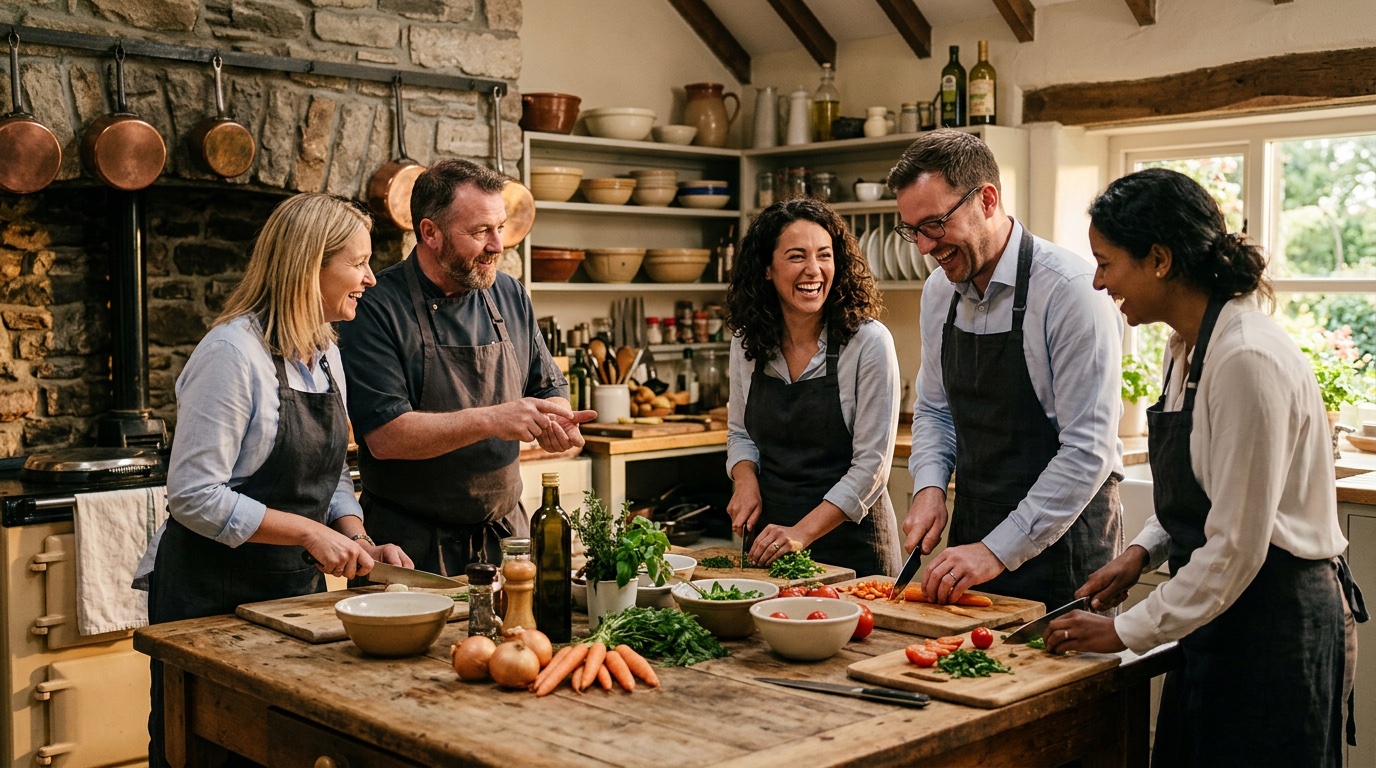
Culinary team building in the UK and Ireland puts US corporate groups inside working kitchens, farm estates, and distilleries where collaboration happens through cooking, tasting, and creating together. From competitive cooking challenges at historic Irish country houses to whisky blending masterclasses in Edinburgh, food-based team building delivers the kind of shared experience that a conference room never will.
Table of Contents
- Types of Culinary Team Building Experiences
- Regional Food Specialties for Corporate Groups
- Top Culinary Venues in Ireland
- Top Culinary Venues in the UK
- Group Sizes, Logistics, and Dietary Accommodation
- Combining Culinary Experiences With Broader Retreats
- Why a DMC Makes Culinary Team Building Work
Types of Culinary Team Building Experiences
Not all culinary team building is the same, and selecting the right format determines whether your group walks away with genuine shared memories or just a forgettable afternoon. The UK and Ireland offer a depth of food-based activities that can be matched precisely to your team’s size, energy level, and corporate objectives.
A culinary team building experience is a structured, participatory activity where every member of the group contributes to preparing, creating, or producing food or drink under guided instruction. It is not a cooking demonstration where your team watches a chef work while sipping wine.
According to the Incentive Research Foundation, experiential team building activities — including culinary formats — generate 40% stronger team cohesion and 28% higher post-event engagement than passive social events. Food-based experiences consistently rank among the top three preferred incentive activities for North American corporate groups.
| Experience Type | Format | Duration | Group Size | Best For |
|---|---|---|---|---|
| Competitive Cooking Challenge | Teams cook against each other; judged by a professional chef | 2-3 hours | 15-120 | High-energy teams, sales groups |
| Farm-to-Table Experience | Visit a working farm, harvest ingredients, cook a meal on-site | 4-6 hours | 10-50 | Sustainability-focused companies, executive groups |
| Guided Food Tour | Walking tour through a city’s food markets and artisan producers | 3-4 hours | 10-40 | Arrival-day activity, mixed-ability groups |
| Cocktail / Whisky Masterclass | Participants learn to mix cocktails or blend whisky under expert guidance | 1.5-2.5 hours | 10-80 | Evening activity, social bonding |
| Chocolate or Confectionery Workshop | Hands-on truffle making, tempering, and flavour creation | 2-3 hours | 10-50 | Creative teams, mixed seniority groups |
| Cheese Making / Artisan Production | Make cheese, butter, or bread from raw ingredients at an artisan dairy or bakery | 3-4 hours | 10-30 | Intimate groups, process-oriented teams |
According to VisitBritain’s food and drink tourism research, 73% of international visitors to the UK identify food experiences as important or very important to their trip satisfaction. For corporate groups, this translates directly: food is the activity your team members will talk about when they return to the office. Passive sightseeing is not what generates lasting engagement.
Competitive cooking challenges work particularly well for large incentive groups because they create natural team structures and a shared sense of achievement. Our corporate retreat planning guide covers how to integrate activities like these into a multi-day itinerary. For more on structuring incentive travel experiences, see our guide to measuring incentive travel ROI and our employee retention and incentive travel analysis.
According to Failte Ireland’s Food and Drink Tourism Strategy, food tourism is now worth over EUR 2 billion annually to the Irish economy, with experiential cooking and tasting activities driving the fastest-growing segment of that market.
Regional Food Specialties for Corporate Groups
The UK and Ireland are not a single food culture — they are four distinct culinary traditions, each with ingredients, techniques, and heritage that give corporate groups something genuinely local and impossible to replicate elsewhere. Building your culinary team building around regional specialties grounds the experience in place, making it an authentic encounter rather than a generic cooking class.
Regional culinary specialties are a defining feature of UK and Ireland food culture, rooted in geography, climate, and centuries of agricultural tradition. They are not interchangeable — Irish seafood chowder, Scottish haggis, English afternoon tea, and Welsh lamb each carry a cultural context that makes them distinct team building platforms.
According to VisitBritain’s food research, 68% of visitors who participate in a food experience tied to regional identity rate their overall trip satisfaction significantly higher than those who dine at non-regional restaurants. For US groups unfamiliar with these traditions, the novelty factor adds a layer of engagement that domestic cooking classes cannot match.
| Region | Signature Ingredients / Dishes | Team Building Format | Key Experience |
|---|---|---|---|
| Ireland (Cork / West Coast) | Atlantic seafood, soda bread, farmhouse cheese, Irish stew | Seafood cookery at Ballymaloe, market tours in English Market Cork | Catch-to-kitchen experiences using locally landed fish |
| Scotland (Edinburgh / Highlands) | Haggis, whisky, smoked salmon, venison, Cullen skink | Whisky blending masterclass, haggis making, Scotch pie challenge | Distillery visit with guided nosing and food pairing |
| England (London / Cotswolds) | Afternoon tea, artisan bread, English sparkling wine, game pies | Afternoon tea masterclass, bread baking, wine tasting at English vineyards | Full-service afternoon tea created and served by the team |
| Wales (Carmarthenshire / Snowdonia) | Welsh lamb, Welsh cakes, Bara brith, Caerphilly cheese, laverbread | Lamb cookery masterclass, Welsh cake baking, cheese making | Farm visits with hands-on lamb butchery and slow cooking |
According to Failte Ireland, Ireland’s Atlantic coast produces some of Europe’s finest shellfish, with oysters from Galway Bay, mussels from Bantry Bay, and brown crab from the Burren coastline all available to corporate cooking experiences. A farm-to-table seafood session at a venue like Ballymaloe Cookery School connects your team to this supply chain directly — from the harbour to the chopping board.
Scotland’s whisky heritage offers a team building format that no other destination can replicate. According to the Scotch Whisky Association, over 2.2 million international visitors toured Scottish distilleries in 2024, making whisky tourism Scotland’s fastest-growing experiential sector. For corporate groups, a guided blending session at a working distillery combines sensory learning with collaborative decision-making, as teams must agree on flavour profiles and ratios under expert supervision.
For groups visiting England, the afternoon tea masterclass is an unexpectedly effective team building format. Teams learn to prepare scones, finger sandwiches, and pastries, then present and serve their own afternoon tea — a task that requires coordination, timing, and presentation skills. Our London corporate events guide and Cotswolds corporate events guide list venues that run these programmes for groups of 15 to 60.
Wales is an underrated culinary destination for corporate groups. Welsh lamb, reared on mountain pastures and salt marshes, is among the finest in the world. Our Wales incentive travel guide details how to build Welsh food experiences into a broader programme.
Top Culinary Venues in Ireland
Ireland’s culinary infrastructure for corporate groups has matured significantly, with dedicated cookery schools, country house kitchens, and urban venues purpose-built for group experiences. For US companies arriving into Dublin or Shannon, these venues sit within easy reach of major airports and pair naturally with broader incentive travel programmes across Ireland.
A top-tier culinary team building venue is a purpose-equipped kitchen with professional instructors, scalable group capacity, and the ability to accommodate dietary requirements across the full group. It is not a restaurant that occasionally clears a corner for a cooking demo.
According to Failte Ireland, food tourism in Ireland generates over EUR 2 billion annually, and the number of dedicated cookery school experiences available to groups has grown 35% since 2022. This investment in food tourism infrastructure means US corporate groups now have access to world-class culinary venues that rival anything in continental Europe.
| Venue | Location | Group Capacity | Signature Experience | Duration |
|---|---|---|---|---|
| Ballymaloe Cookery School | Shanagarry, Co. Cork | 15-60 | Farm-to-fork cookery using 100-acre organic farm produce | Half-day or full-day |
| Ashford Castle | Cong, Co. Mayo | 10-80 | Castle kitchen cookery with estate-sourced ingredients | 2-4 hours |
| FIRE Restaurant & Lounge | Dawson Street, Dublin | 15-50 | Irish steak masterclass and cocktail making in the Mansion House | 2-3 hours |
| The English Market Experience | Cork City | 10-40 | Guided market tour with artisan tastings, followed by a cooking session | 3-4 hours |
| Cliff at Lyons | Celbridge, Co. Kildare | 10-40 | Kitchen garden cookery using estate-grown produce | 2-4 hours |
Ballymaloe Cookery School in East Cork is Ireland’s most renowned culinary institution and a world-class team building destination. Founded by Darina Allen, the school sits on a 100-acre organic farm where groups harvest their own ingredients before cooking. According to Ballymaloe Cookery School, the school has hosted over 40,000 students since opening and has been named among the world’s top cookery schools by Food & Wine Magazine and Conde Nast Traveler. Corporate groups work in teams across dedicated workstations, guided by Ballymaloe-trained instructors, and sit down to eat what they have cooked together. The farm-to-fork philosophy is what makes Ballymaloe fundamentally different from urban cooking classes — the ingredient journey from soil to plate happens within the same 100 acres.
Ashford Castle in Co. Mayo offers culinary team building inside an 800-year-old castle on a 350-acre lakeside estate. Groups cook with produce sourced from the estate’s kitchen gardens and local suppliers. According to Ashford Castle, the property holds Forbes Five-Star status and can combine cooking experiences with falconry, archery, and lake activities for a full-day retreat programme. Our corporate retreat planning guide covers how to structure multi-activity itineraries at estate venues.
FIRE Restaurant on Dawson Street in Dublin operates from the historic Lord Mayor’s Lounge in the Mansion House and offers corporate groups a premium Irish steak cooking experience. For groups arriving into Dublin, FIRE provides a convenient city-centre option that pairs with our Dublin corporate events guide recommendations.
For groups visiting Ireland’s south and west coasts, the Cork and Wild Atlantic Way corporate guide and Galway corporate events guide detail how to combine culinary venues with regional sightseeing and activities.
Top Culinary Venues in the UK
The UK’s culinary team building infrastructure spans from purpose-built urban cookery schools in London and Edinburgh to country estate kitchens in the Cotswolds and Scottish Highlands. Each venue category offers a distinct format, and the right choice depends on where your group is based during their trip, how much time is allocated, and whether the cooking experience needs to stand alone or integrate with a broader programme.
A UK culinary venue is evaluated on three criteria for corporate groups: kitchen capacity for the group size, quality of instruction, and the ability to create a memorable experience that justifies transatlantic travel. It is not sufficient for a venue to simply have a large kitchen — the experience must be curated, instructed, and distinctive.
According to VisitBritain, food and drink experiences are now the third-highest-rated activity among international visitors to the UK, behind only heritage sites and landscape visits. Corporate groups are a growing segment of this demand, with dedicated cookery school operators reporting 25% year-on-year increases in group bookings.
| Venue | Location | Group Capacity | Signature Experience | Duration |
|---|---|---|---|---|
| Edinburgh New Town Cookery School | Edinburgh, Scotland | 12-48 | Scottish menu cooking challenge with local produce | 2-4 hours |
| Cookery School at Little Portland Street | Central London, England | 10-50 | Competitive cooking, cocktail making, themed cuisine nights | 2-4 hours |
| Gleneagles Cookery School | Perthshire, Scotland | 10-30 | Scottish game and seafood masterclass on an 850-acre estate | 3-5 hours |
| Daylesford Cookery School | Cotswolds, England | 10-30 | Organic farm cookery with farm tour and seasonal menus | Half-day or full-day |
| The Avenue Cookery School | Wandsworth, London | 12-60 | MasterChef-style competitive team cooking | 2-3 hours |
Edinburgh New Town Cookery School has operated since 1989 and is Scotland’s longest-running independent cookery school. According to the school, corporate groups work in teams of 4-6 at dedicated cooking stations, guided by the school’s professional instructors, to prepare a full Scottish menu using locally sourced ingredients. The school sits in Edinburgh’s Georgian New Town — a UNESCO World Heritage Site — making it an ideal pairing with our Edinburgh corporate events guide.
The Cookery School at Little Portland Street in Central London offers a flexible urban space that accommodates competitive cooking challenges, themed cuisine nights, and cocktail masterclasses. Its central location near Oxford Circus makes it logistically convenient for groups based in London hotels. According to the school, their MasterChef-style corporate events are their most-booked format, with teams competing to prepare, plate, and present a three-course meal under time pressure. Our London corporate events guide covers additional venue options.
Gleneagles in Perthshire combines culinary team building with the estate’s wider offering — golf, outdoor pursuits, spa, and conference facilities. According to Gleneagles, groups can cook with produce from Perthshire’s farms and estates, including venison, grouse, and Scottish seafood, before dining on their creations in the hotel’s private dining spaces. For groups spending multiple days in Scotland, Gleneagles serves as both the culinary venue and the base for a broader retreat programme. Our Scottish Highlands corporate retreat guide details the broader regional options.
For groups heading to the Cotswolds, Daylesford Cookery School on the Daylesford organic farm offers a farm-to-table format similar to Ballymaloe’s Irish model. Our Cotswolds corporate events guide covers the full range of team building and incentive options in the region.
Group Sizes, Logistics, and Dietary Accommodation
The logistics of culinary team building for corporate groups are more nuanced than booking a restaurant reservation. Kitchen capacity, station allocation, ingredient sourcing for dietary requirements, and timing within a broader itinerary all need to be coordinated with precision — particularly when your group is 3,000 miles from home.
Dietary accommodation in culinary team building is a core planning requirement that must be resolved at the booking stage, with ingredient substitutions and parallel preparation stations confirmed in writing. It is not an afterthought handled by swapping out one ingredient on the day of the event.
According to Food Standards Agency UK data and Food Safety Authority of Ireland guidance, the 14 major food allergens must be identified and managed in any commercial cooking environment. For corporate groups where participants are cooking and handling food, this creates an additional layer of responsibility that professional culinary venues are equipped to manage — and informal kitchen settings are not.
| Group Size | Recommended Format | Venue Requirement | Staffing Ratio | Typical Setup Time |
|---|---|---|---|---|
| 10-20 | Single session, one kitchen | Cookery school or hotel kitchen | 1 instructor per 10 participants | 30 minutes |
| 20-40 | Team stations (4-6 per team) | Purpose-built cookery school with multiple stations | 1 instructor per 12-15 participants | 45 minutes |
| 40-80 | Competitive challenge with parallel stations | Large cookery school or hotel conference kitchen | 1 instructor per 15 + head chef judge | 60-90 minutes |
| 80-120 | Split rotation or multi-activity food festival | Hotel or estate with multiple kitchen and activity spaces | Multiple instructors + event coordinator | 90-120 minutes |
| Dietary Requirement | Accommodation Approach | Advance Notice Needed | Venue Capability Check |
|---|---|---|---|
| Vegetarian / Vegan | Parallel ingredient stations; plant-based menu option | 14 days | Standard at all professional venues |
| Gluten-free | Dedicated gluten-free workstation; substitute flour and thickeners | 14 days | Standard at cookery schools; verify at hotels |
| Halal / Kosher | Certified halal/kosher ingredient sourcing; separate preparation area | 21 days | Available at major city venues; advance coordination in rural areas |
| Severe Allergies (nut, shellfish) | Isolated preparation area; allergen-free ingredient set; EpiPen on-site | 21 days | Cookery schools equipped; hotel kitchens may require modification |
| Multiple Combined Restrictions | Bespoke menu designed with venue chef; pre-event ingredient review | 28 days | DMC coordinates directly with head chef |
According to Failte Ireland, food tourism operators across Ireland have invested in allergen management systems and inclusive menu design as part of the national food tourism strategy. The same is true across the UK, where the Food Standards Agency has strengthened allergen labelling requirements — meaning professional venues operate to a high baseline of dietary awareness.
For groups over 40, a split rotation model often works best: half the group does the cooking challenge while the other half participates in a complementary activity — such as a whisky tasting, cocktail class, or guided food tour — and then the groups swap. This maximises kitchen capacity while ensuring everyone gets adequate hands-on time. Our MICE tourism guide covers how to structure multi-activity programmes efficiently.
Transport logistics between hotels and culinary venues also require planning. Many of Ireland’s best cookery schools are in rural locations — Ballymaloe is 30 minutes east of Cork city — and UK venues like Daylesford are deep in the Cotswolds countryside. A DMC arranges private coach transfers timed to the session schedule. For transport specifics, see our group travel logistics guide and our DMC vs. DIY cost-value analysis.
Combining Culinary Experiences With Broader Retreats
Culinary team building works best when it is woven into a broader corporate programme rather than treated as a standalone event. Food experiences function as natural connective tissue between business sessions, outdoor activities, and cultural exploration — and the UK and Ireland’s concentrated geography makes it possible to combine multiple experience types within a single day.
A culinary experience within a broader retreat is a planned programme element with specific timing, objectives, and connections to the day’s other activities. It is not a filler activity inserted because there is a gap in the schedule.
According to the Incentive Research Foundation, multi-activity incentive programmes that blend experiential, cultural, and business elements generate 35% higher participant satisfaction scores than single-format events. Culinary team building scores particularly well because it delivers both a social bonding experience and a tangible output — the meal itself — which creates a natural transition into evening dining and networking.
| Programme Day | Morning | Afternoon | Evening |
|---|---|---|---|
| Day 1: Arrival (Dublin) | Airport transfers; hotel check-in | Guided food tour of Dublin (Temple Bar, George’s Street Arcade) | Welcome dinner at FIRE Restaurant, Dawson Street |
| Day 2: Cork / Ballymaloe | Transfer to Cork; English Market tour with artisan tastings | Competitive cooking challenge at Ballymaloe Cookery School | Seated dinner of group-prepared dishes at Ballymaloe |
| Day 3: Wild Atlantic Way | Coastal walk or kayaking on the Wild Atlantic Way | Afternoon strategy session at hotel | Seafood cookery class at a coastal venue; group dining |
| Day 4: Departure | Irish soda bread baking workshop; farewell brunch | Transfers to Cork or Shannon Airport | — |
| Retreat Objective | Culinary Element | Complementary Activity | Region |
|---|---|---|---|
| Sales team incentive | Competitive cooking challenge with prizes | Whisky distillery tour, golf, castle dining | Scotland (Edinburgh / Highlands) |
| Leadership retreat | Farm-to-table experience with group reflection | Strategy sessions, forest bathing, wellness spa | Ireland (Cork / Kildare) |
| Company-wide offsite | Food festival format with multiple stations | Cultural tours, team challenges, gala dinner | London / Cotswolds |
| New team integration | Chocolate workshop or cheese making (low pressure) | Walking tour, pub quiz, informal group dining | Dublin / Edinburgh |
| Wellness-focused retreat | Nutritional cooking class with local organic produce | Yoga, mindfulness, spa treatments, nature walks | Ireland (West Cork) / Wales |
According to VisitBritain, corporate groups that combine culinary experiences with cultural and outdoor activities spend an average of 22% more per head than groups booking culinary activities in isolation — reflecting both the richer itinerary and the higher engagement levels that multi-format programmes generate.
For a Scotland-based retreat, a morning at the Edinburgh New Town Cookery School pairs naturally with an afternoon whisky experience on the Royal Mile, or a transfer to the Scottish Highlands for outdoor pursuits the following day. For wellness-oriented groups, culinary experiences integrate smoothly with the spa and nature therapy programming detailed in our corporate wellness retreats guide and our mindfulness retreats for leadership teams.
Groups combining food experiences with sustainable travel practices can build in CSR and volunteer elements — such as cooking for a local charity or supporting a community food project — that add purpose alongside pleasure.
Why a DMC Makes Culinary Team Building Work
Coordinating culinary team building across the UK and Ireland from a US office introduces variables that most internal event teams have never navigated: venue kitchen capacity, allergen legislation that differs from US requirements, instructor sourcing, ingredient availability by season, and transport logistics to rural cookery school locations. A Destination Management Company with culinary programme experience eliminates these unknowns.
A DMC’s role in culinary team building is end-to-end programme design, supplier coordination, dietary management, and on-site execution that ensures the cooking experience runs to professional standards. It is not limited to booking a venue and handing over a confirmation email.
According to the Incentive Research Foundation, 82% of corporate event planners who use a DMC for international experiential events report higher participant satisfaction than those who coordinate directly with venues. The gap is widest for food-based activities, where local relationships, seasonal ingredient knowledge, and venue familiarity directly impact the quality of the experience.
| Planning Element | Without a DMC | With a DMC |
|---|---|---|
| Venue selection | Limited to venues with English-language marketing to US market | Access to full network including private kitchens and estate venues |
| Dietary management | Event planner collects data and communicates to venue | DMC manages dietary matrix, coordinates ingredient sourcing, verifies on-site |
| Instructor quality | Venue’s standard team | DMC sources specialist chefs and adjusts based on group profile |
| Transport to rural venues | Event planner researches and books coaches separately | DMC provides private coaches timed to session schedules |
| Integration with broader programme | Culinary experience stands alone; separate vendor for other activities | DMC weaves cooking into multi-day itinerary with seamless transitions |
| On-site management | Event planner manages logistics remotely or travels with group | DMC programme manager present to handle real-time adjustments |
According to Failte Ireland, the most successful food tourism experiences in Ireland are those where a knowledgeable local operator curates the experience end-to-end — from ingredient sourcing to storytelling about the food’s provenance. A DMC provides this curatorial layer for corporate groups, ensuring the culinary team building goes beyond cooking mechanics to deliver a genuine connection to the destination’s food culture.
Cashel Travel’s DMC services cover Ireland, Scotland, England, and Wales — meaning a single partner coordinates culinary team building across all four regions, whether your programme visits one country or spans both islands. For a detailed comparison of DMC-managed versus self-organised events, see our DMC vs. DIY cost-value analysis. To understand the broader value framework, explore our business case for international corporate retreats and our overview of what a DMC does.
Frequently Asked Questions
How many people can participate in a culinary team building session in the UK or Ireland?
Most culinary team building venues in the UK and Ireland accommodate groups of 10 to 80 participants in a single session. Purpose-built cookery schools like Ballymaloe in Cork handle up to 60 in their main teaching kitchen, while competitive cooking challenges at hotel venues like Ashford Castle can scale to 120 by running parallel kitchen stations. For groups over 80, a DMC typically splits the programme across two rotations or runs simultaneous food activities — such as a cooking challenge for one group and a cocktail masterclass for the other — at different stations within the same venue.
What dietary restrictions can culinary team building experiences accommodate?
Professional culinary team building venues in the UK and Ireland routinely accommodate vegetarian, vegan, gluten-free, dairy-free, halal, and kosher dietary requirements. Most venues request dietary information 14-21 days before the event and prepare parallel ingredient stations so restricted participants cook alongside the group using substituted ingredients. Severe allergies — nuts, shellfish, dairy — require dedicated preparation areas with full allergen isolation, which purpose-built cookery schools can provide. A DMC collects dietary data during the registration process, coordinates directly with venue chefs, and verifies allergen management protocols on-site before the group arrives.
How much does culinary team building cost per person in the UK and Ireland?
Culinary team building costs range from GBP 65 to GBP 250 per person depending on the format and venue. A two-hour cocktail making workshop in Dublin or London runs GBP 65-95 per person. Half-day competitive cooking challenges at dedicated cookery schools cost GBP 95-150 per person. Full-day farm-to-table experiences — including market visits, hands-on cooking, and a seated group meal — run GBP 150-250 per person. Premium venue experiences at locations like Ballymaloe Cookery School or Gleneagles carry higher per-person rates but include access to estate grounds, expert-led instruction, and fine dining presentation. A DMC negotiates group rates that are typically 10-20% below direct booking prices.
Can culinary team building be combined with other corporate retreat activities?
Culinary team building integrates naturally into broader corporate retreat programmes and is most effective when paired with complementary activities. A typical three-day incentive trip might combine a morning strategy session with an afternoon cooking challenge, or pair a farm-to-table experience with a guided coastal walk or wellness activity. Venues like Ashford Castle and Gleneagles offer culinary programming alongside outdoor pursuits, spa access, and conference facilities on a single estate. A DMC builds hybrid itineraries that use food experiences as connective elements between business sessions, team activities, and regional exploration.
What makes culinary team building different from a standard group dinner?
Culinary team building requires active participation, real-time collaboration, and shared problem-solving under time pressure — dynamics that a seated dinner does not create. Participants work in small teams, dividing tasks, managing resources, and presenting a finished dish for professional judging. This structure mirrors workplace dynamics in a low-stakes environment and makes communication patterns and leadership behaviours visible in ways that social dining cannot achieve. According to the Incentive Research Foundation, experiential activities generate 40% stronger team cohesion than passive social events, and culinary challenges consistently rank among the highest-engagement formats for corporate groups.
Ready to build a culinary team building programme for your group? Contact Cashel Travel to start planning. As a specialist DMC for the UK and Ireland, we source the right venues, manage dietary requirements across your full group, coordinate transport to rural cookery schools, and provide on-site programme management — so your team focuses on cooking together, not logistics.