Group Travel Logistics: US to UK & Ireland
Moving a group of 20 to 200 people across the Atlantic demands precision at every stage. From block-fare flight bookings and immigration processing to ground transport coordination and real-time communication plans, group travel logistics between the US and the UK & Ireland require a level of planning that goes well beyond booking a hotel and hoping for the best.
Table of Contents
- Group Flight Booking Strategies
- Direct Routes: US Airports to UK & Ireland
- Arrival Logistics: Immigration and US Preclearance
- Ground Transport: Coaches, Minibuses, and Rail
- Luggage Logistics and Multi-Venue Coordination
- Communication Plans and Time Zone Management
- Travel Documents, Emergency Protocols, and DMC Coordination
Group Flight Booking Strategies
Booking flights for a corporate group is not the same as booking 50 individual tickets. Airlines operate dedicated group desks with separate inventory and pricing structures, and understanding how to work these systems is the difference between paying a premium and securing a rate that makes your CFO comfortable.
Block fares are the standard mechanism for group air travel. When you request a block fare from an airline’s group department, you are reserving a set number of seats at a negotiated rate — typically 10-20% below published fares for groups of 10 or more. According to IATA’s passenger traffic analysis (2025), transatlantic load factors averaged 87% in 2025, which means popular routes fill early and block allocations must be secured months in advance.
| Booking Method | Best For | Minimum Group Size | Lead Time Required | Typical Savings |
|---|---|---|---|---|
| Airline Group Desk (Block Fare) | Fixed itinerary, confirmed dates | 10+ | 4-6 months | 10-20% vs. published fares |
| Consolidator / Wholesaler | Flexible dates, price-sensitive | 20+ | 3-5 months | 15-25% vs. published fares |
| Charter Flight | 100+ pax, specific routing needs | 100+ | 6-12 months | Variable (cost certainty) |
| Individual Bookings (Managed) | Staggered arrivals, mixed origins | Any | 2-3 months | None (retail rates) |
A group flight booking is a contract with specific deposit deadlines, name-change policies, and cancellation windows that differ from retail tickets. It is not a batch of regular bookings bundled together after the fact.
For US-based groups departing from multiple cities, hub routing consolidates travellers through a single gateway — typically JFK, Newark, Chicago O’Hare, or Boston Logan — where the full group boards one transatlantic flight together. According to Airlines for America (A4A), hub-and-spoke routing remains the most cost-effective model for transatlantic group travel, reducing per-person costs by consolidating onto a single high-capacity aircraft.
Work with a DMC that understands flight logistics to coordinate deposits, name lists, and seat assignments. Our corporate retreat planning guide covers the broader budgeting framework, including air travel allocations.
Direct Routes: US Airports to UK & Ireland
Choosing the right departure airport and routing is a logistical decision that ripples through every other element of your group travel plan. Direct flights minimize connection risks, reduce travel fatigue, and make group arrival coordination far simpler.
According to OAG Aviation Worldwide, the number of direct transatlantic routes between the US and UK/Ireland reached a record high in 2025, driven by demand recovery and new aircraft deliveries. Here are the primary direct routes your group should consider:
| US Airport | Direct to Dublin (DUB) | Direct to London (LHR/LGW) | Direct to Edinburgh (EDI) | Direct to Shannon (SNN) | Key Airlines |
|---|---|---|---|---|---|
| JFK (New York) | Yes (6h 40m) | Yes (7h 00m) | Yes (6h 45m) | Seasonal | Aer Lingus, Delta, British Airways, JetBlue |
| BOS (Boston) | Yes (5h 50m) | Yes (6h 40m) | Seasonal | Yes (5h 30m) | Aer Lingus, Delta, JetBlue |
| ORD (Chicago) | Yes (7h 20m) | Yes (8h 00m) | Seasonal | Seasonal | Aer Lingus, American, United |
| EWR (Newark) | Yes (6h 50m) | Yes (7h 10m) | Yes (7h 00m) | No | United, Aer Lingus |
| IAD (Washington Dulles) | Yes (7h 10m) | Yes (7h 30m) | No | No | United, Aer Lingus, British Airways |
| SFO (San Francisco) | Yes (10h 10m) | Yes (10h 30m) | No | No | Aer Lingus, United, British Airways |
| CLT (Charlotte) | Yes (7h 30m) | Yes (8h 00m) | Seasonal | No | American |
A direct flight is a non-negotiable priority for groups of 30 or more — a missed connection for even 5 people can derail your entire first-day programme. It is not always the cheapest option, but the risk mitigation justifies the cost difference.
For itineraries that span both the UK and Ireland, consider open-jaw routing: fly into Dublin, travel overland through Ireland, cross to the UK, and fly home from London or Edinburgh. This eliminates backtracking and gives your group a broader experience. Our guide to Edinburgh corporate events and Dublin corporate events guide cover what awaits at each end of that route.
According to Dublin Airport Authority (daa), Dublin Airport handled over 33 million passengers in 2025, with North American traffic growing 12% year-over-year — a clear signal that transatlantic connectivity to Ireland continues to strengthen.
If your group is based on the US East Coast, Shannon Airport offers a strategic alternative. It’s a smaller, faster-processing airport with US Preclearance facilities, and it places your group on Ireland’s west coast — ideal for itineraries featuring the Ring of Kerry, the Dingle Peninsula, or Galway.
Arrival Logistics: Immigration and US Preclearance
What happens in the first 90 minutes after your group lands sets the tone for the entire trip. Immigration processing, baggage collection, and meet-and-greet coordination must be choreographed — not left to chance.
According to US Customs and Border Protection, Dublin Airport and Shannon Airport are the only airports in Europe that offer US Preclearance. This means your group completes US immigration, customs, and agriculture inspection before boarding the return flight to the US. On arrival stateside, every member of your group walks off the aircraft as a domestic passenger — bypassing what can be a 60-90 minute immigration queue at busy US hubs.
| Arrival Scenario | Immigration Process | Estimated Group Processing Time (50 pax) | Key Consideration |
|---|---|---|---|
| Arriving UK (Heathrow) | UK Border Force — e-Gates or manned desks | 30-60 minutes | US passport holders can use e-Gates; no visa required for stays under 6 months |
| Arriving Ireland (Dublin) | Irish Immigration — manned desks | 20-45 minutes | No visa required for US citizens; 90-day stay permitted |
| Returning via Dublin (Preclearance) | US CBP Preclearance at Dublin Airport | 45-75 minutes (before departure) | Arrive at airport 3.5 hours before flight; land in US as domestic |
| Returning via Shannon (Preclearance) | US CBP Preclearance at Shannon Airport | 30-50 minutes (before departure) | Smaller facility, faster processing; ideal for groups under 80 |
| Returning via London (No Preclearance) | Standard US immigration on arrival | 45-90 minutes (after landing in US) | Factor in connection time at US hub; 2-hour minimum for onward flights |
US Preclearance is a genuine logistical advantage that can save your group half a day of productivity on the return journey. It is not available at any UK airport — so if your itinerary ends in London, Edinburgh, or Manchester, your group will face standard US immigration queues upon landing in the US.
For groups arriving into the UK, the UK Government’s e-Gate system allows US passport holders aged 12 and over to use automated gates at major airports including Heathrow, Gatwick, Manchester, and Edinburgh. According to Heathrow Airport, e-Gate processing averages under 30 seconds per person — but queues to reach the gates themselves can add 15-20 minutes during peak morning arrival windows (06:00-09:00).
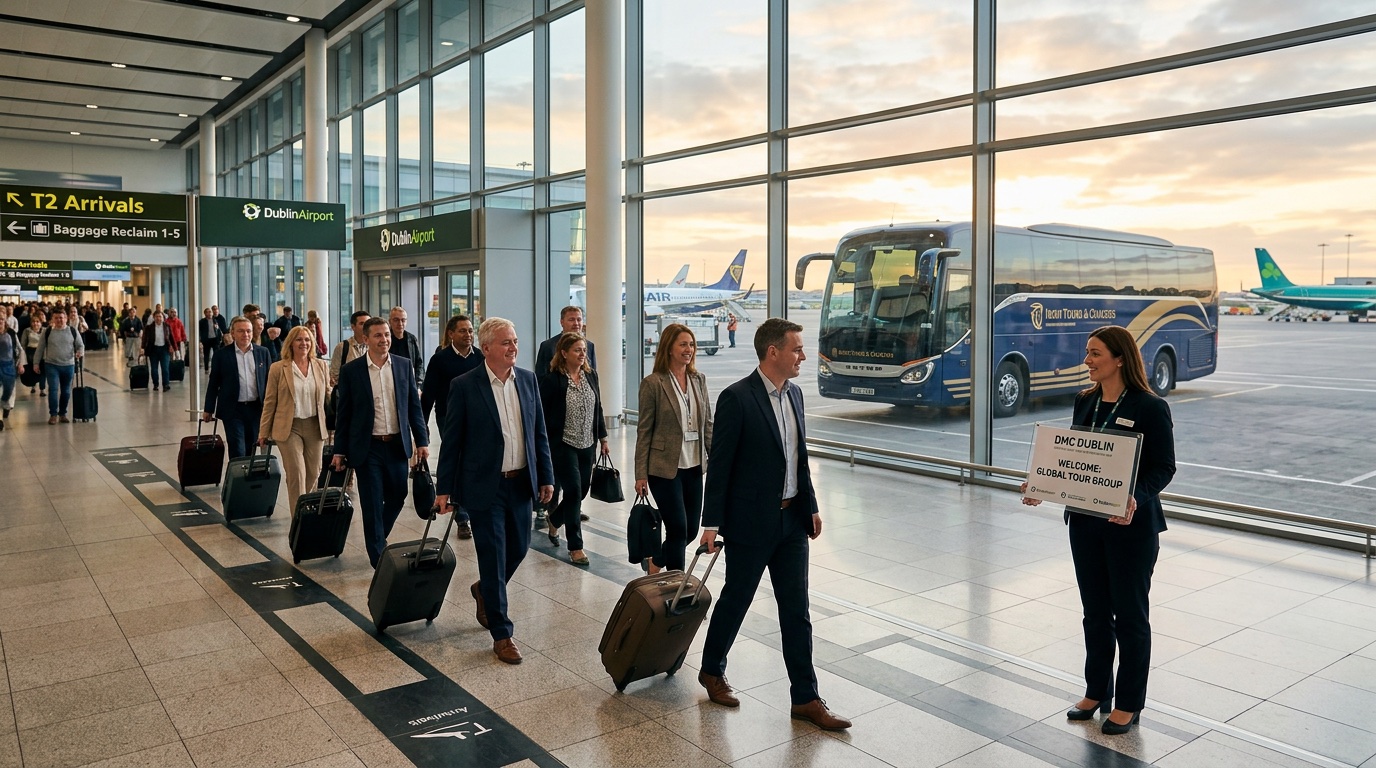
A DMC arranges airside or landside meet-and-greet services at the arrival airport, with staff holding group signage, managing headcounts, and directing travellers to pre-staged coaches. For more on how ground support works for corporate groups, see our overview of what a DMC does and our corporate retreat planning framework.
If your itinerary includes both the UK and Ireland, note that the Common Travel Area (CTA) between the UK and Ireland means there are typically no immigration checks on travel between the two — but this applies to British and Irish citizens. US passport holders crossing from Northern Ireland to the Republic (or vice versa) will not encounter a physical border, but should carry passports at all times.
Ground Transport: Coaches, Minibuses, and Rail
Once your group clears the airport, ground transport becomes the backbone of every logistical decision for the rest of the trip. Vehicle selection affects scheduling, routing options, venue accessibility, and group comfort — and the UK and Ireland present specific considerations that differ from US domestic transport.
| Vehicle Type | Capacity | Luggage Hold | Best For | Typical Day Rate (GBP) |
|---|---|---|---|---|
| Luxury Minibus | 16 seats | Limited (soft bags only) | VIP transfers, executive groups, narrow rural roads | £450-£700 |
| Midi-Coach | 24-33 seats | Underslung hold for 25-30 cases | Mid-size groups, mixed road conditions | £550-£850 |
| Executive Coach | 49 seats | Full underslung hold (45+ cases) | Large groups, motorway-heavy routes | £700-£1,100 |
| Full-Size Coach | 53 seats | Full underslung hold (50+ cases) | Maximum capacity, city-to-city transfers | £750-£1,200 |
| Private Cars / MPVs | 3-6 seats | Boot / trunk only | VIP arrivals, airport-to-hotel for leadership | £200-£400 |
According to the Confederation of Passenger Transport UK (CPT), the UK’s licensed coach fleet includes over 30,000 vehicles, with the executive and luxury segments growing 8% in 2025 to meet corporate demand. Ireland’s fleet is smaller but highly professional, with operators like JJ Kavanagh, Irish City Tours, and local DMC-contracted fleets serving the corporate sector.
Ground transport in the UK and Ireland is a regulated, driver-hours-compliant operation where EU-derived tachograph rules still apply — meaning your driver must take mandatory breaks and cannot exceed daily driving limits. It is not comparable to US charter bus logistics where regulations vary by state and enforcement is inconsistent.
| Route | Mode | Duration | Group Suitability | Notes |
|---|---|---|---|---|
| Dublin to Galway | Coach | 2h 30m | All group sizes | Motorway (M6); comfortable, fast |
| Dublin to Belfast | Coach or Rail | 2h (coach) / 2h 10m (rail) | 20-50 on rail; any size by coach | Cross-border; no passport check at border |
| London to Edinburgh | Rail (LNER) | 4h 20m | Up to 100 (group carriage bookings) | City centre to city centre; scenic east coast route |
| Edinburgh to Scottish Highlands | Coach | 3h-5h (depending on destination) | All group sizes | Single-track roads common; 33-seat midi-coach recommended |
| London to Cotswolds | Coach | 1h 30m-2h | All group sizes | Narrow village roads; 49-seat max in most villages |
| Shannon to Ring of Kerry | Coach | 2h 30m | Max 49-seat coach on Ring road | Ring of Kerry one-way system for coaches; anti-clockwise only |
Rail is a strong option for specific corridors. According to LNER (London North Eastern Railway), group bookings of 10+ receive discounted fares and can reserve dedicated carriages on the London-Edinburgh route. The journey itself — passing through York, Durham, and along the Northumberland coast — doubles as an experience. For groups visiting Edinburgh before heading to the Scottish Highlands, coach transport from Edinburgh is the only practical option for reaching remote venues.
In Ireland, narrow rural roads are a reality on popular routes like the Ring of Kerry and the Dingle Peninsula. Full-size 53-seat coaches are restricted on some stretches, and the Ring of Kerry operates a mandatory anti-clockwise one-way system for coaches. Our Galway corporate events guide and group tours in Ireland overview cover regional routing in more detail.
Luggage Logistics and Multi-Venue Coordination
Luggage is the logistical element that most corporate travel planners underestimate. For a group of 50, you are managing 50-100 pieces of checked luggage, carry-on bags, presentation equipment, branded materials, and potentially golf clubs or activity gear. Without a system, chaos at the carousel becomes chaos at the coach, which becomes chaos at the hotel.
| Luggage Challenge | Solution | When to Implement |
|---|---|---|
| Airport carousel collection for 50+ bags | DMC luggage coordinator with group manifests; colour-coded bag tags | Pre-departure: tags mailed to travellers |
| Coach hold capacity limitations | Separate luggage vehicle for multi-venue trips | Booked at itinerary planning stage |
| Multi-hotel itinerary bag transfers | Porter service at each venue; bags moved while group is on programme | Coordinated 24 hours ahead of each move |
| Branded materials and AV equipment | Ship separately via freight to first venue; DMC receives and stages | Shipped 5-7 business days before arrival |
| Lost or delayed baggage | DMC emergency kit (toiletries, basic clothing contacts); airline liaison | Standing protocol for all group arrivals |
Luggage logistics is a dedicated workstream that requires its own coordinator, timeline, and contingency plan. It is not something that sorts itself out once the group reaches the hotel.
For multi-venue itineraries — such as a programme that moves from Dublin to Galway to the Dingle Peninsula — a separate luggage vehicle is the gold standard. The group’s bags are collected from one hotel and delivered to the next while the group is engaged in activities or travelling by coach. According to Tourism Ireland, multi-destination itineraries account for over 60% of North American group travel to Ireland, making luggage logistics a recurring operational requirement.
The pre-departure bag tag system is worth the effort. Colour-coded or numbered tags — matched to a master manifest that links each traveller to their room allocation — allow porters to route bags directly to rooms without a lobby queue. Your DMC should provide these tags as part of the pre-trip communication pack.
For branded materials, AV equipment, or event staging supplies, ship these separately via a freight forwarder to the first venue. UK and Irish customs clearance for commercial goods requires documentation, and your DMC will handle the receiving, inspection, and staging of these items before the group arrives. See our MICE tourism guide for more on event-specific logistics.
Communication Plans and Time Zone Management
When your group is 5-8 hours ahead of the home office and spread across coaches, venues, and activity sites, your communication plan is the thread that holds the operation together. A poorly planned communication structure leads to missed buses, schedule confusion, and a travel manager fielding 50 individual WhatsApp messages at midnight.
| Communication Tool | Use Case | Pros | Cons |
|---|---|---|---|
| WhatsApp Group | Real-time updates, schedule changes, casual coordination | Universal, free, works on Wi-Fi; read receipts | Can become noisy; no structured info retrieval |
| Dedicated Travel App (e.g., TripIt, Groupize) | Itinerary access, flight info, venue details, maps | Structured, searchable, offline access | Requires pre-trip setup and onboarding |
| Printed Itinerary Cards | Daily schedule, emergency contacts, venue addresses | Works without signal or battery; tactile reference | Cannot be updated in real time |
| DMC On-Site Coordinator (Radio/Phone) | Inter-vehicle communication, venue liaison, emergency escalation | Immediate response, professional escalation chain | Requires DMC with dedicated ground staff |
A group communication plan is a layered system with at least three channels — digital broadcast, structured reference, and human escalation. It is not a single WhatsApp group where critical updates get buried under restaurant selfies.
According to a 2025 survey by the Global Business Travel Association (GBTA), 78% of corporate travel managers cited real-time communication with group members as their biggest logistical challenge on international trips. The solution is a tiered approach:
Tier 1 — Broadcast channel (WhatsApp or Signal group): For real-time schedule updates, coach departure reminders, and weather alerts. Restrict posting to the travel manager and DMC coordinator. All other participants on read-only.
Tier 2 — Reference platform (travel app or shared document): Full itinerary with venue addresses, dress codes, dietary information, and local emergency numbers. Participants access this self-serve — reducing the volume of repetitive questions on the broadcast channel.
Tier 3 — Human escalation (DMC coordinator, 24/7 local phone): For genuine issues — medical, lost passports, transport breakdowns. This number should be on the printed itinerary card that every traveller carries.
| Time Zone | Offset from EST | Offset from PST | Key Implication for Group Scheduling |
|---|---|---|---|
| GMT / UTC (UK & Ireland, winter) | +5 hours | +8 hours | Morning departures at 8am local = 3am EST |
| BST / IST (UK & Ireland, summer) | +5 hours (EDT) | +8 hours (PDT) | Same offset; but later evening daylight enables late programme scheduling |
| Cross-over window (EST overlap) | 2pm-6pm local = 9am-1pm EST | — | Schedule any home-office calls in this window |
Time zone management matters for two reasons: keeping the home office looped in, and managing group energy. Jet lag hits hardest on days 1-2 eastbound. According to the Mayo Clinic, eastward travel produces more severe jet lag symptoms than westward, with a general rule of one day of adjustment per time zone crossed. For a group crossing 5-8 zones, build a lighter first-day programme — a walking city tour or welcome dinner rather than a full-day conference session. Our London corporate events guide includes suggestions for low-intensity arrival-day activities.
Plan all home-office touchpoints for the 2pm-6pm local window (9am-1pm EST), and communicate this schedule to stakeholders before departure. Our incentive travel budget planning guide discusses how to factor communication and scheduling costs into your programme design.
Travel Documents, Emergency Protocols, and DMC Coordination
The final layer of group travel logistics is the framework that handles everything that can go wrong — and ensures that your standard operations run without friction even when conditions change. Document management, emergency preparedness, and DMC coordination are the elements that separate a professionally managed group trip from an improvised one.
| Document / Requirement | UK | Ireland | Action Required |
|---|---|---|---|
| US Passport | Required; 6+ months validity recommended | Required; 6+ months validity recommended | Verify all passports 90 days before departure |
| Visa | Not required (stays under 6 months) | Not required (stays under 90 days) | Confirm all travellers hold US passports; non-US nationals may need visas |
| ESTA / ETA | UK ETA required from 2025 for some nationalities (not US citizens) | Not applicable for US citizens | Check non-US passport holders against UK ETA requirements |
| Travel Insurance | Strongly recommended; no reciprocal healthcare for US citizens | Strongly recommended; no reciprocal healthcare for US citizens | Arrange group policy covering medical, repatriation, trip cancellation |
| Corporate Travel Policy Compliance | Duty of care obligations | Duty of care obligations | Share itinerary with corporate security/travel risk team |
According to the UK Government, US citizens entering the UK for business purposes — including conferences, corporate events, and meetings — do not require a visa for stays up to 6 months. However, this does not cover paid work. If any group members will be conducting work that falls outside “permitted business activities,” separate visa advice is needed.
Travel document management is a pre-departure compliance task that must be completed 90 days before travel, with a verification checkpoint at 30 days. It is not something to address at the airport when a traveller discovers their passport expired last month.
Emergency protocols should be documented, distributed, and rehearsed with your on-site team:
| Emergency Scenario | Response Protocol | Responsible Party |
|---|---|---|
| Medical emergency | Call 999 (UK) or 112 (Ireland/EU); DMC coordinator accompanies to hospital; group travel insurance activated | DMC on-site coordinator |
| Lost or stolen passport | Contact nearest US Embassy/Consulate (London, Dublin, Edinburgh, Belfast); DMC arranges emergency travel document | Travel manager + DMC |
| Flight cancellation (outbound or return) | DMC rebooks via airline group desk; extends hotel and transport as needed; communication to group via Tier 1 channel | DMC logistics team |
| Coach breakdown | Replacement vehicle dispatched within 60-90 minutes (DMC maintains backup supplier list); group held at safe location | DMC transport coordinator |
| Severe weather disruption | Contingency indoor programme activated; alternative venues on standby; group notified via Tier 1 and Tier 2 channels | DMC programme manager |
An emergency protocol is a pre-written, role-assigned response plan that every member of the on-site team has reviewed before the group arrives. It is not a reactive scramble that begins when something goes wrong.
According to the US State Department’s Smart Traveler Enrollment Program (STEP), enrolling your group in STEP provides real-time safety alerts for your destination countries and makes it easier for the nearest US Embassy to reach your group in a genuine emergency. For groups of 50+, a DMC will typically register the group’s itinerary with the relevant consular offices as standard practice.
The DMC’s role in all of this is coordination. A specialist DMC like Cashel Travel acts as the single point of accountability for every logistical thread — flights, ground transport, venues, luggage, communication, and emergency response. Rather than your travel manager juggling 15 separate vendor relationships across two countries and multiple time zones, the DMC consolidates everything into one operational plan with one escalation number.
For a deeper understanding of how this coordination model works, explore our guide to what a DMC is, our DMC vs. DIY cost-value analysis, and our sustainable corporate travel guide for groups that want to embed responsible practices into their logistics framework.
Frequently Asked Questions
How far in advance should we book group flights from the US to the UK and Ireland?
Begin the booking process 6-9 months before departure for groups of 20 or more. Airlines open group desk allocations 330 days out, and block fares for 20+ seats require lead times of at least 4-6 months. Peak summer travel and major event periods demand 9-12 months of lead time. A DMC with airline relationships can secure provisional holds before names are finalized, giving your group flexibility while locking in favourable rates.
What is US Preclearance and why does it matter for group travel?
US Preclearance is a facility at Dublin Airport and Shannon Airport where your group clears US Customs and Border Protection before boarding the return flight. Everyone arrives back in the US as domestic passengers — no immigration queues, no customs lines, no secondary baggage screening. For groups of 50 or more, this saves 60-90 minutes per person on arrival, which is critical when coordinating onward domestic connections.
What size coaches are available for corporate group transport in the UK and Ireland?
Coach options range from 16-seat luxury minibuses to 53-seat full-size executive coaches. For groups of 20-30, a 33-seat midi-coach balances comfort and manoeuvrability on narrow rural roads. Groups of 40-53 use full-size coaches with onboard Wi-Fi, USB charging, and luggage holds. For groups over 53, multiple coaches travel in convoy with a DMC coordinator on each vehicle.
Do US citizens need a visa to travel to the UK and Ireland for corporate events?
US citizens do not need a visa for either country. The UK permits visa-free entry for up to 6 months for business activities including conferences and corporate events. Ireland allows visa-free stays of up to 90 days. The UK and Ireland operate separate immigration systems, so groups crossing both jurisdictions clear immigration in each country. All travellers need a valid US passport with at least 6 months remaining validity.
How should we handle luggage logistics for a large corporate group?
For groups of 30 or more, assign a dedicated luggage coordinator. Use colour-coded bag tags linked to a master manifest and room allocation list. At the airport, a DMC coordinator manages carousel collection and coach loading. For multi-venue itineraries, a separate luggage vehicle transports bags between hotels while the group is on programme — eliminating load and unload delays at every stop.
Ready to take the logistics off your plate? Contact Cashel Travel to start planning your group’s transatlantic programme. As a specialist DMC for the UK and Ireland, we handle every logistical detail — from block-fare flight coordination and airport meet-and-greet to multi-vehicle ground transport and 24/7 on-site support — so your travel manager can focus on the programme, not the plumbing.