Corporate Wellness Retreats in the UK & Ireland
Corporate wellness retreats in the UK and Ireland give US companies access to world-class spa destinations, nature therapy landscapes, and structured wellbeing programs that produce measurable returns. From thermal suites in the Scottish Highlands to digital detox estates on Ireland’s Atlantic coast, these retreats combine clinical wellness with environments that simply don’t exist stateside.
Table of Contents
- Why the UK and Ireland for Corporate Wellness Retreats
- Types of Corporate Wellness Retreat Programs
- Top Wellness Retreat Venues by Region
- The Business Case: Wellness Retreat ROI Data
- Planning a Wellness Retreat Itinerary
- Seasonal Considerations for Wellness Travel
- Working With a DMC for Wellness Retreat Logistics
Why the UK and Ireland for Corporate Wellness Retreats
The UK and Ireland have emerged as leading destinations for corporate wellness travel, combining centuries-old spa traditions with modern wellbeing science. For US-based HR leaders evaluating international retreat locations, these regions deliver a rare combination: clinical-grade wellness facilities inside heritage properties surrounded by some of Europe’s most therapeutic natural landscapes.
A corporate wellness retreat is a structured program designed to reduce employee stress, prevent burnout, and build sustainable health habits through immersive experiences. It is not a spa weekend rebranded with a corporate credit card.
According to the Global Wellness Institute’s 2025 Economy Monitor, the global wellness economy reached $6.8 trillion in 2024 and is forecast to hit $9.8 trillion by 2029. The corporate wellness segment alone was valued at $68 billion in 2025, with North America accounting for over 40% of demand. US companies are the largest buyers, and the UK and Ireland are among the most accessible international destinations to deliver on that investment.
Direct flights from New York, Boston, Chicago, and other major US hubs land in Dublin, London, or Edinburgh in 6-8 hours. The shared language eliminates friction with wellness practitioners, venue staff, and activity guides. And the time zone overlap (5-8 hours ahead of the US) creates natural windows where teams can disconnect from US operations during morning wellness sessions and reconnect briefly in the afternoon if needed.
| Factor | UK & Ireland | Continental Europe | US Domestic |
|---|---|---|---|
| Flight time from US East Coast | 6-8 hours | 8-11 hours | 1-6 hours |
| Language barrier | None | Moderate-High | None |
| Heritage wellness venues | Extensive (castles, estates) | Extensive (alpine, thermal) | Limited |
| Nature therapy environments | Coastal, moorland, forest | Alpine, Mediterranean | Varies by region |
| Visa requirement for US citizens | No | No (Schengen 90 days) | N/A |
| Perceived “retreat” experience | High (distance creates disconnect) | High | Lower (too familiar) |
Explore our full range of destinations across the UK and Ireland to see what’s possible for your team’s wellness program.
Types of Corporate Wellness Retreat Programs
Not every team needs the same wellness intervention. The most effective corporate wellness retreats match program type to organizational need, whether that’s executive burnout recovery, team-wide stress management, or proactive resilience building.
A wellness retreat program is a curated sequence of evidence-based activities designed around specific health and performance outcomes. It is not an unstructured free day at a hotel spa.
According to the World Health Organization’s guidelines on mental health at work, organizational interventions that directly target working conditions and environments deliver the strongest outcomes. The WHO specifically recommends that employers implement proactive, culture-wide wellbeing initiatives rather than reactive support alone.
| Retreat Type | Best For | Core Activities | Duration | Ideal UK/Ireland Setting |
|---|---|---|---|---|
| Spa & Thermal Wellness | Executive burnout recovery | Hydrotherapy, massage, thermal suites, sleep therapy | 3-4 days | Monart (Ireland), Gleneagles (Scotland) |
| Mindfulness & Mental Health | High-stress teams, post-restructure | Guided meditation, breathwork, journaling, counseling | 3-5 days | Burren (Ireland), Lake District (England) |
| Nature Therapy & Forest Bathing | Screen-heavy teams, creative roles | Shinrin-yoku, wild swimming, coastal walks, sound baths | 2-4 days | Wild Atlantic Way (Ireland), Highlands (Scotland) |
| Digital Detox | Always-on culture, remote teams | Device surrender, analog activities, nature immersion | 3-5 days | Isle of Eriska (Scotland), West Cork (Ireland) |
| Active Fitness & Adventure | Competitive teams, younger demographics | Hiking, kayaking, wild swimming, yoga, nutrition | 3-5 days | Snowdonia (Wales), Kerry (Ireland) |
According to CIPD’s Health and Wellbeing at Work Report 2025, mental health remains the primary focus of 89% of organizations’ employee wellbeing activity, with 29% of employers expecting their wellbeing budget to increase over the next 12 months. This signals growing demand for structured retreat programming rather than ad-hoc wellness perks.
The most successful programs we coordinate through our Ireland DMC services blend multiple modalities. A three-day retreat might open with a guided coastal mindfulness walk, transition into afternoon spa treatments, and close each evening with nutritional dining experiences using local Irish produce. This variety prevents wellness fatigue and ensures different personality types within your team find their entry point.
For teams that need a more structured case for investment, our case studies document measurable outcomes from past wellness programs.
Top Wellness Retreat Venues by Region
Venue selection determines the character of your entire wellness retreat. The UK and Ireland offer a depth of spa and wellness properties that ranges from five-star castle estates to intimate boutique retreats, each with distinct strengths for corporate groups.
A wellness venue is a facility with dedicated spa infrastructure, trained practitioners, and purpose-built spaces for health-focused programming. It is not a standard hotel that happens to have a gym and a sauna.
Ireland
Ireland’s wellness infrastructure combines world-class spa facilities with landscapes that are inherently therapeutic. The Wild Atlantic Way coastline, the ancient Burren karst landscape, and the stillness of Wexford’s woodlands provide natural environments that complement any indoor wellness program.
According to Failte Ireland, the country has invested heavily in wellness tourism infrastructure, with multiple properties now holding international spa certifications.
| Venue | Location | Wellness Strengths | Group Capacity | Standout Feature |
|---|---|---|---|---|
| Monart Destination Spa | Wexford | Thermal suite, hydrotherapy, 15 treatment rooms | 20-60 | Adults-only; 100 acres of private woodland |
| Ashford Castle (The Spa) | Mayo | Forbes Five-Star Spa, bespoke treatments | 20-120 | 350-acre estate with falconry, fishing, and equestrian |
| The Lodge at Ashford Castle | Mayo | Intimate spa, nature walks, wild garden | 10-30 | Smaller sister property, more intimate groups |
| Cliff at Lyons | Kildare | Wellness garden, thermal area, mindfulness programs | 15-50 | 40-minute drive from Dublin; easy access |
Monart Destination Spa in Wexford is consistently ranked among the top 1% of five-star hotels globally by Tripadvisor and has been celebrated by Conde Nast Traveler as one of the finest spa destinations worldwide. Its adults-only policy and 100-acre private woodland setting create the focused environment that corporate wellness retreats require.
Explore our Ireland incentive travel programs and Ireland DMC services for full venue sourcing.
Scotland
Scotland offers a unique combination of luxury spa estates and raw Highland landscapes. The country’s wellness tradition draws on its natural assets: clean air, ancient forests, thermal waters, and a quietness that is increasingly rare in corporate life.
| Venue | Location | Wellness Strengths | Group Capacity | Standout Feature |
|---|---|---|---|---|
| Gleneagles | Perthshire | 20 treatment rooms, thermal suite, Wild Wellness program | 20-150 | 850 acres; Michelin-starred dining; corporate events team |
| Isle of Eriska | Argyll | Spa, nature walks, total seclusion | 10-25 | Private island; digital detox by geography |
| Stobo Castle | Scottish Borders | Destination spa, Japanese water garden, 25m pool | 15-40 | One hour from Edinburgh; purpose-built spa castle |
Gleneagles’ Wild Wellness retreat program is a nature-based wellness program developed in collaboration with naturopath Rosemary Ferguson. The 850-acre estate offers 20 spa treatment rooms, two indoor pools, an outdoor thermal pool, and hydrotherapy facilities, alongside corporate meeting spaces with dedicated event management. This blend of wellness infrastructure and corporate capability makes it particularly strong for executive-level retreats.
Our Scotland DMC team and Scotland incentive programs handle venue coordination, wellness practitioner sourcing, and full logistics.
England
England’s wellness venue market is the most mature in the UK, with dedicated destination spas that have operated for decades alongside newer luxury estate wellness offerings.
| Venue | Location | Wellness Strengths | Group Capacity | Standout Feature |
|---|---|---|---|---|
| Champneys (Tring, Forest Mere, Henlow, Springs) | Multiple locations | Full destination spa, fitness, nutrition programs | 20-80 per property | UK’s original health spa brand; 4 locations |
| Ragdale Hall | Leicestershire | Thermal spa, rooftop infinity pool, 50+ treatments | 20-60 | Purpose-built spa with corporate packages |
| Rudding Park | Yorkshire | Roof-top spa, immersive experiences, garden rooms | 20-50 | Innovative spa design with garden-to-treatment concept |
Champneys has operated as a dedicated health spa brand since 1925, making it one of the oldest wellness-focused hospitality groups in Europe. Its four properties across England offer varying specializations, from forest-based wellness at Forest Mere to nutritional retreats at Tring. Our England DMC services can coordinate multi-venue wellness itineraries that combine a London arrival with a countryside spa retreat.
Wales
Wales offers exceptional value for wellness retreats, with venues that punch above their price point and landscapes, particularly the Brecon Beacons and Snowdonia, that rival anywhere in the British Isles for nature therapy programming.
| Venue | Location | Wellness Strengths | Group Capacity | Standout Feature |
|---|---|---|---|---|
| Celtic Manor Resort | Newport | Forum Spa, hydrotherapy pool, fitness center | 30-200 | Former Ryder Cup venue; extensive conference facilities |
| Bodysgallen Hall & Spa | Llandudno | Spa, walled gardens, mountain views | 10-30 | National Trust property; 200-acre estate |
Our Wales DMC specialists source wellness venues that deliver premium experiences at rates 20-30% below equivalent English or Scottish properties, making Wales an intelligent option for budget-conscious wellness programs without compromising quality.
The Business Case: Wellness Retreat ROI Data
The financial argument for corporate wellness retreats is now supported by substantial research. For US HR leaders building a business case, the data from major UK and global studies provides the evidence needed to secure C-suite approval.
Wellness retreat ROI is measurable through a combination of healthcare cost reduction, absenteeism data, productivity metrics, and retention rates tracked over 6-12 months. It is not a feel-good metric that relies solely on post-event satisfaction surveys.
According to Deloitte UK’s 2024 mental health research, employers receive an average return of GBP 4.70 for every GBP 1 invested in workplace mental health and wellbeing initiatives. Universal wellbeing programs available to all employees, the category that corporate wellness retreats fall into, generate an even higher return of GBP 6.30 for every GBP 1 invested. Deloitte’s research also found that poor mental health costs UK employers GBP 51 billion annually, with presenteeism alone accounting for GBP 24 billion.
| ROI Metric | Finding | Source |
|---|---|---|
| Return per GBP 1 invested (all programs) | GBP 4.70 | Deloitte UK (2024) |
| Return per GBP 1 invested (universal programs) | GBP 6.30 | Deloitte UK (2024) |
| Healthcare savings per USD 1 invested | USD 3.27 | Harvard Business Review meta-analysis |
| Absenteeism reduction per USD 1 invested | USD 2.73 | Harvard Business Review meta-analysis |
| Reduction in sick days | 56% fewer | Wellable (2025) |
| Productivity increase | Up to 20% | Wellable (2025) |
| Employee retention improvement | 53% less likely to leave | Wellable (2025) |
| Average absence days per employee (UK) | 9.4 days/year (15-year high) | CIPD (2025) |
According to CIPD’s 2025 Health and Wellbeing at Work Report, UK employee absence has risen to 9.4 days per employee per year, the highest level in more than 15 years. Mental ill health is now the leading cause of long-term absence and the second most common cause of short-term absence. For US companies with UK-based teams, or those benchmarking against international standards, these figures underscore the urgency of proactive wellness interventions.
The World Health Organization recommends that employers implement organizational-level interventions that directly target working conditions and environments, rather than placing the burden of mental health management on individual employees. Immersive wellness retreats represent exactly this type of organizational intervention: a company-led, structured environment that removes employees from stressors and provides tools for sustainable wellbeing.
For every dollar your organization currently loses to absenteeism, presenteeism, and turnover, a well-designed wellness retreat program recovers multiples. Contact our team to discuss how we structure wellness retreat proposals with built-in measurement frameworks.
Planning a Wellness Retreat Itinerary
The difference between a forgettable spa day and a transformative wellness retreat lies in itinerary design. Effective corporate wellness programming builds in rhythm: alternating between active and restorative sessions, group and individual time, structured and unstructured moments.
A wellness itinerary is a carefully sequenced program that progressively deepens the participant’s engagement with health and stress-reduction practices. It is not a packed schedule of back-to-back activities that creates its own form of stress.
Here is a sample four-day corporate wellness retreat itinerary based on a combined Ireland and Scotland format. This template can be adapted to any venue combination across our destinations.
| Day | Morning (9:00-12:00) | Afternoon (13:30-16:30) | Evening (18:00-21:00) |
|---|---|---|---|
| Day 1: Arrival & Reset | Airport transfers; estate orientation walk | Guided forest bathing session; spa orientation | Welcome dinner (farm-to-table); intention-setting circle |
| Day 2: Active Wellness | Morning yoga; guided coastal or lakeside hike | Spa treatments (massage, hydrotherapy); or wild swimming | Nutrition workshop with estate chef; guided journaling |
| Day 3: Deep Restoration | Mindfulness meditation; breathwork session | Free time: spa, nature walks, or creative workshop | Sound bath or live acoustic music; group reflection |
| Day 4: Integration & Departure | Closing yoga; personal action plan workshop | Farewell lunch; departures | — |
According to the Global Wellness Institute, the most effective workplace wellness initiatives are those that combine multiple modalities, including physical activity, mental health support, and nutritional guidance, rather than focusing on a single dimension of health.
Key itinerary design principles we apply through our DMC services:
- Buffer time between sessions. Allow 30-60 minutes between activities for personal reflection and informal peer connection.
- Optional participation. Not everyone is comfortable with group meditation or wild swimming. Build parallel tracks so no one feels coerced.
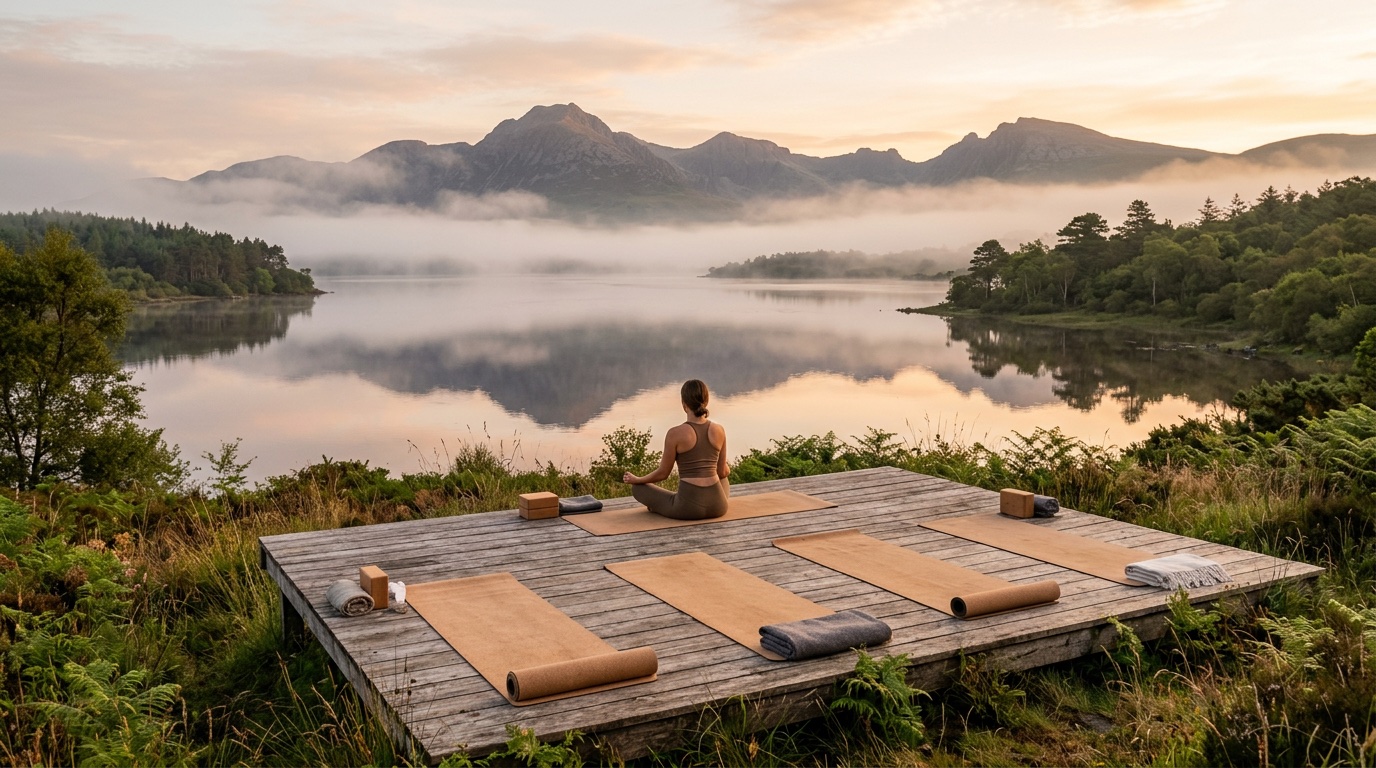
- Local integration. Use the destination itself as a wellness tool. A guided walk through the Burren’s limestone landscape or along Scotland’s coastline is inherently therapeutic.
- Action planning. The final session should always focus on what participants will carry home. Without an integration plan, retreat benefits fade within 2-3 weeks.
Our team has coordinated wellness retreats across every region. See how we’ve structured past programs in our case studies, or learn more about what a DMC does in the planning process.
Seasonal Considerations for Wellness Travel
The UK and Ireland’s temperate but changeable climate means each season creates a distinctly different wellness retreat experience. Choosing the right time of year shapes everything from available outdoor activities to venue pricing and team energy levels.
Seasonal timing is a strategic decision that directly affects program design, cost, and participant experience. It is not simply a matter of finding dates that work on everyone’s calendar.
| Season | Months | Weather | Best Retreat Types | Pricing | Considerations |
|---|---|---|---|---|---|
| Spring | April-May | 10-16C (50-61F); lengthening days | Nature therapy, active fitness, mindfulness | Mid-range | Wildflower season in Ireland; lambing season in Wales |
| Summer | June-August | 15-22C (59-72F); 16-18 hour daylight | All types; outdoor-focused programs | Peak | Longest days; wild swimming season; highest demand |
| Autumn | September-October | 10-16C (50-61F); golden light | Spa, mindfulness, forest bathing | Shoulder (best value) | Harvest-season cuisine; autumn foliage; reduced tourist crowds |
| Winter | November-March | 3-8C (37-46F); short days | Spa & thermal, digital detox | Low season | Cozy atmosphere; thermal spa contrast; limited outdoor options |
According to Deloitte’s workplace wellbeing research, early intervention and proactive programs deliver higher returns than reactive support. Timing your retreat to fall before high-stress business periods, such as Q4 planning or year-end close, positions it as a preventive measure rather than a response to burnout that has already occurred.
For US companies, the autumn shoulder season (September-October) is often the optimal window. It falls after summer holiday season, venue rates are 15-25% below peak, and the mild weather still supports outdoor programming. The Scottish Highlands and Irish countryside are particularly striking in autumn light, adding a visual dimension to nature therapy sessions that summer crowds dilute.
Winter retreats work exceptionally well for spa-focused programs. Venues like Monart in Wexford and Ragdale Hall in Leicestershire operate full thermal suites year-round, and the contrast between cold outdoor air and heated spa environments enhances the physiological benefits of hydrotherapy. Scotland’s shorter winter days (as few as seven hours of daylight) create a natural framework for deep rest and digital disconnection.
Our Scotland DMC and England DMC teams build weather contingency into every program, ensuring indoor alternatives are confirmed at the venue stage, not discovered on the day of the event.
Working With a DMC for Wellness Retreat Logistics
Coordinating a corporate wellness retreat across the UK and Ireland from a US office introduces logistical layers that internal event teams rarely encounter. Wellness retreats carry additional complexity beyond standard corporate travel: practitioner sourcing, dietary coordination for wellness menus, spa scheduling for large groups, and the seamless integration of therapeutic programming with corporate objectives.
A DMC (Destination Management Company) is a local ground specialist that manages every logistical and experiential element of your retreat, from airport to departure gate. It is not a travel agent that simply books hotels and flights.
According to the CIPD’s 2025 report, only 50% of organizations believe their wellbeing efforts are effective despite 64% taking active steps. The gap often lies in execution, not intent. A DMC bridges that gap by ensuring the wellness program design translates into a seamless on-the-ground experience.
What a wellness-specialist DMC handles:
- Venue sourcing and vetting. We audit wellness facilities, practitioner credentials, and spa capacity against your group’s specific needs before shortlisting.
- Practitioner coordination. Sourcing certified yoga instructors, mindfulness facilitators, nutritionists, and therapists who have experience with corporate groups, not just individual guests.
- Dietary and accessibility management. Wellness menus require more nuance than standard catering. We coordinate with venue chefs on plant-based, anti-inflammatory, or elimination diet programs, alongside standard dietary requirements.
- Spa scheduling. Getting 30 people through a 15-room spa requires precise time-blocking. We manage treatment scheduling so no one waits and no session runs behind.
- Transport and transfers. Private coaches from Dublin, Edinburgh, or London airports to rural wellness venues, with timing built around jet lag recovery rather than venue convenience.
- On-site program management. A dedicated program manager present throughout the retreat handles the inevitable adjustments: weather changes, schedule shifts, individual participant needs.
| Planning Element | Without a DMC | With a DMC |
|---|---|---|
| Venue shortlisting | Online research; limited to marketed properties | Curated from 200+ vetted venues; insider access |
| Wellness practitioners | Venue’s in-house team only | External specialists matched to program objectives |
| Cost management | Published rack rates | Pre-negotiated rates; 15-25% savings typical |
| Weather contingency | Discovered on the day | Indoor alternatives pre-confirmed at venue stage |
| On-site support | None (internal team manages remotely) | Dedicated program manager on-site throughout |
| Post-retreat measurement | Ad hoc satisfaction survey | Structured ROI framework with 30/60/90-day tracking |
Learn more about what a DMC is and how the model works, or explore our support and FAQ section for detailed guidance on the planning process.
Frequently Asked Questions
How much do corporate wellness retreats in the UK and Ireland cost per person?
Corporate wellness retreat budgets in the UK and Ireland typically range from $300-$700 per person per day, depending on venue tier and the depth of wellness programming included. For a full 3-5 day international retreat including flights from the US, expect $4,000-$7,000 per employee at a mid-to-premium level. Spa-inclusive venues like Gleneagles and Monart Destination Spa carry higher per-night rates but bundle treatments into the stay, which can reduce overall costs compared to booking wellness activities separately. Working with a DMC typically saves 15-25% through pre-negotiated local supplier rates.
What is the best time of year for a corporate wellness retreat in the UK or Ireland?
Spring (April-May) and early autumn (September-October) offer the strongest combination of mild weather, venue availability, and value pricing. Shoulder seasons deliver rates 15-25% below peak summer while still supporting outdoor wellness activities like forest bathing, coastal walks, and nature therapy. Winter retreats work well for spa-focused programs where thermal suites and indoor wellness are the core offering. Venues like Monart in Wexford, Champneys in England, and Ragdale Hall operate full thermal and hydrotherapy facilities year-round regardless of season.
What types of wellness activities are available at UK and Ireland retreat venues?
UK and Ireland venues offer extensive wellness programming including spa therapies (thermal suites, hydrotherapy, massage, facials), mindfulness and meditation, forest bathing and nature immersion, digital detox programs, yoga and breathwork, active fitness (hiking, wild swimming, kayaking), nutritional workshops with local produce, and sleep optimization. Premium venues like Gleneagles offer purpose-built Wild Wellness programs, while Ashford Castle’s Forbes Five-Star Spa provides bespoke treatment journeys. A DMC can source external practitioners to supplement venue offerings for corporate-specific programming.
How do you measure the ROI of a corporate wellness retreat?
Measure wellness retreat ROI through pre- and post-retreat employee surveys tracking stress levels, engagement, and job satisfaction. Monitor absenteeism rates at 30, 60, and 90 days post-retreat and compare healthcare claims data over the following 6-12 months. Track retention rates among retreat attendees versus non-attendees. According to Deloitte UK’s research, employers receive an average return of GBP 4.70 for every GBP 1 invested in wellbeing initiatives, with universal programs generating GBP 6.30 per GBP 1.
Can a DMC customize a corporate wellness retreat for our specific team needs?
Yes. A Destination Management Company specializing in UK and Ireland wellness retreats assesses your team’s wellness objectives, group demographics, dietary and accessibility requirements, and budget to build a fully bespoke program. This includes sourcing certified wellness practitioners (yoga instructors, mindfulness facilitators, nutritionists), coordinating with venue spa teams on group treatment schedules, arranging specialist activities like wild swimming guides or sound bath practitioners, and providing on-site program management throughout. Contact Cashel Travel to start a tailored wellness retreat consultation.
Cashel Travel is a Destination Management Company specializing in corporate wellness retreats, incentive travel, and group experiences across Ireland, Scotland, England, and Wales. Our team designs fully bespoke wellness programs with measurable outcomes for US-based companies. [Get in touch](https://casheltravel.com/contact/) to start planning your team’s wellness retreat.